|
|

Sunday, April 28, 2024
|
|


|
||||||||||
|
Kashmir is known throughout the world as much for its arts and crafts as for its scenic beauty and bracing climate. The diverse articles range from woolen textiles of fleecy soft texture and matchless excellence in weaving, hand-woven carpets of finest warp and weft, to the exquisite designs worked on papier-mâché, wood work, silverware, etc are the products of unique craftsmanship.
The chain-stitch is also used for the making of a large number of miscellaneous articles such as bags, screens and cushion covers. A unique position among Kashmir textiles is held by the celebrated shawl. The process of shawl-making is fascinating from the start. Assiduously, women sort out of the lustrous, rough substance from the smooth fleecy wool of the Kel goat, and they ply it over a charkha (handloom) of the indigenous type, while chanting folk-songs. This fabric, called pashimina, takes two forms of the loom: the loom shawl (entirely woven on the loom ) and the embroidered shawl, which is woven with an embroidered pattern. The celebrated 'ring shawl' has been given in the popular name, because it can actually pass through a ring. Rare and different from the others is the Jamavar shawl. In this case, the threads of the warp and weft are dyed before weaving. The peculiar charm of this famous shawl is derived from the symphony of colour schemes depicting architectural and mythological figures interwoven with landscape designs. A high-class shawl is expected to have the designs worked evenly on both sides. The price of a pashmina shawl may range anywhere from a few hundred rupees to thousands of rupees, depending upon the craftsmanship and the time factor involved in its creation. The namda, felt rug, made from beaten wool, which is then embroidered over, is an important branch of the kasida industry of Kashmir. The
gabba- a unique type of
floor covering, prepared fro
The chain-stitch rung, which resembles the gabba carpet, is also manufactured economically, as the base is Hessian cloth and coarse wool, over which floral and other motifs are worked. The carpet industry, introduced into the Valley by Sultan Zain-ul-Abidin, justly renowned. From the point of weaving, carpets are broadly divided into two classes: smooth-faced carpets and pile carpets. Pile carpets (kalins), made in Kashmir since the Muslim rule, attained great perfection. Worked with floral and other designs, the hand-woven pile carpet became the national craft of Kashmir. The flora and fauna of different lands-Kashmir, Central Asia and Iran are depicted on the carpets of Kashmir in a harmony symbolic of traditional synthesis of Kashmir's diverse cults and cultures.
|
||||||||||
|
||||||||||||||||||||||||
|
||||||||||||||||||||||||
Related Links |
| ▪ Government |
| ▪ Classifieds |
| ▪ Education |
| ▪ Yellowpages |
| ▪ Photo Gallery |
| Last Updated on : 21 May 2018 |


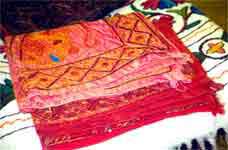 The embroidery of Kashmir, called
kasida, is world-famous. Varied, rich in colour, elaborate in detail and exquisite
in execution, the kasida patterns are freely drawn by the naqqash mostly from
memory. The finest kasida work, particularly embroidered on shawls or saris, has
no 'wrong' side.
The embroidery of Kashmir, called
kasida, is world-famous. Varied, rich in colour, elaborate in detail and exquisite
in execution, the kasida patterns are freely drawn by the naqqash mostly from
memory. The finest kasida work, particularly embroidered on shawls or saris, has
no 'wrong' side.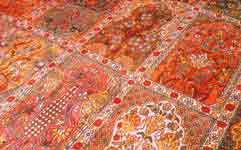 m old woolens in a variety of forms and designs-
come next to the namda industry, and its manufacture is localised at Anantnag
(Islamabad). Baramulla specialises in printed gabbas.
m old woolens in a variety of forms and designs-
come next to the namda industry, and its manufacture is localised at Anantnag
(Islamabad). Baramulla specialises in printed gabbas.