|
Musical Instruments
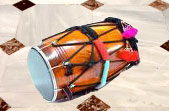 Among percussion instruments, the important ones are the dhol, nagara,
daba, khol, mridanga, jaidhol etc. The dhol, the common drum, is used
in Bihu dance.
Among percussion instruments, the important ones are the dhol, nagara,
daba, khol, mridanga, jaidhol etc. The dhol, the common drum, is used
in Bihu dance.
Taka, a simple instrument of a piece of bamboo-tube split
from one side, is beaten to keep time measurement in Bihu song and
dance. Others are generally used in religious functions, the khol being
the principal tala instrument for Vaishnava music. Jaidhol is also used
in wedding ceremonies. Khanjari, small and light and a combination
of drum and cymbals, also belongs to this class.
Wind instruments (Susir) used for Assamese folk
music are the flute, the Ciphung bahi of the Bodos, the kali, the pepa,
the singa and the gagana. The Ciphung is a long bamboo flute played at
Bodo festivals. Kali, like its more developed version the sehnai, is played
in wedding ceremonies. The singa, from sing (horn) is made of a buffalo
horn with a little bamboo pipe thrust into it, some hill-folk use an ox-horn
also. Pepa, inseparable from the Bihu festival, is in fact only a reed-pipe
which is usually connected to a buffalo-horn. Gagana is a small, split-bamboo
instrument, very finely cut and delicate. It is played by young women
by holding it between the teeth, striking with the right forefinger, allowing
the wind to pass as and when necessary.
The stringed instruments (tala) used by villagers are
the tokari, the been and the serja or serenda. The Tokari, played like
an ektara or a sitar, is widely used by folk singers and also by wandering
minstrels who sing mystic songs like Deh Bicarar Geets. The sarod-like
serenda is a Bodo instrument played with a bow. Been is also played with
a bow, it is an evening companion of village youths who may roam about
playing lilting folk-tunes. Of the Ghana classes the most important is
the tal (cymbals) which has many a ramification like bhortal, khutital,
karatal, mandira etc. Bhortal, the largest pair of cymbals, used by the
Vaishnavas, is reputed to have been imported from the Bhotas or Bhutias.
The tiniest, the Khutital, is played by Oja-Pali performers Kah, a flat
bell, and ghanta, sounded during the progress of a worship, fall under
the ghana class. |