| Durga
Puja
The most important of festival in West Bengal is Durga Puja, held in autumn.
In the past era, it was organised and financed by the landlords and the
business barons and was participated by all sections of people.
 Preparations
start long before the festival. The group images are built up, stage by
stage out of bamboo and straw frame work and layers of clay and finally
tempera and rich clothes and costume jewellery. The group consist of seven
figures. Preparations
start long before the festival. The group images are built up, stage by
stage out of bamboo and straw frame work and layers of clay and finally
tempera and rich clothes and costume jewellery. The group consist of seven
figures.
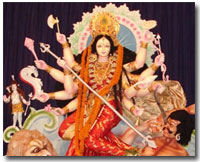
The central figure is that of the ten-armed Durga, the great
deliverer, standing astride a lion and piercing the chest of the ferocious
half buffalo-half man demon Mahishasura with a spear, grasped in one among
her ten hands, while each of her other hand holds a traditional weapon.
On either side of her are seated the goddesses Lakshmi and Saraswati
representing wealth and learning, respectively. The former has an owl
and the latter a swan for their mounts. A little in front of them are
Ganesha, God of commerce, with a mouse for his mount and Kartikeya, God
of war, seated flamboyantly on a peacock. The four deities are supposed
to be the children of Mother Durga. The images depict her annual visit
to her parents place on earth from her heavenly abode on Mount Kailas.
A semi circular panel at the back of and above the group shows in a number
of sections, pictures in pat style portraying the Mother's household and
the various stages of her preparations for the journey.
The puja season constitutes West Bengal's longest holidays.
It is a festive season for all. It is particularly a grand time for children
who are given gaily coloured new dresses to wear and choice eatables,
necessarily including sweetmeats, to eat. The actual puja runs through
five days, starting with the ritual installation of the deity, the ceremonial
worship for three days and immersion of the image in a river or a tank
on the final day. Durga puja has come to be associated with a grand exhibition
of cultural functions. In towns and villages, the evenings are replete
with jatra, theatre, song, music, dance programmes, sports, physical and
cultural competitions etc which everyone is free to attend. Community
feasts are held.
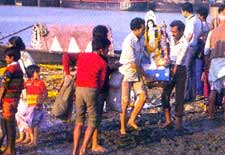 The
immersion ceremony (vijaya), provides an impressive finale. The image
is carried to the water front in a procession with music and drums and
after the immersion everyone greets everyone in a fraternal embrace and
visitors to every home are treated to sweetmeats. The Kolkata area, where
many thousands of pujas are organised in different mohallas, offers
a grand spectacle with a fair-like atmosphere in the streets and markets
and brisk buying and selling of articles for utility and beauty are made.
Handicrafts have a hey day. Fairs are held everywhere on the Vijaya (victory)
day. The
immersion ceremony (vijaya), provides an impressive finale. The image
is carried to the water front in a procession with music and drums and
after the immersion everyone greets everyone in a fraternal embrace and
visitors to every home are treated to sweetmeats. The Kolkata area, where
many thousands of pujas are organised in different mohallas, offers
a grand spectacle with a fair-like atmosphere in the streets and markets
and brisk buying and selling of articles for utility and beauty are made.
Handicrafts have a hey day. Fairs are held everywhere on the Vijaya (victory)
day.
The festive season continues till Kalipuja which takes
place about three weeks after. Here, the image of Kali, the Dark Goddess
who destroys evil to preserve creation, is that of a blue back nude female
with four hands, holding a curved scimitar in one hand and the severed
head of a demon in each of two hands, the fourth hand being raised in
a gesture of reassurance. She has a garland of severed heads dangling
from the neck to the groin. She has stepped on the supine body of her
consort Siva, the realisation of which fact makes her halt in her indiscriminate
orgy of destruction and makes her bite her projecting tongue in abashment.
She is the Goddess of primeval power, a tantric concept at variance with
that of Durga whom Bengalis worship as the Benevolent Mother. Animal sacrifices
are usually made to the Goddess except in the pujas organised by public
subscription.
|