|
Islands and Shoreline
The islands are largely low leveled
flat-topped and generally rise to a height of a few metres above sea. Occasionally old dunes on the sides of the
lagoons and storm beaches on the seaward side of the islands consist of a sandy
beach at places, beach rock is exposed at low tide mark. The eastern shore in
all the islands (except Kadmat, Agatti, Bangaram and Cheriyakara) is marked by storm
beaches, of coral pebbles and boulders piled up well above the high tide mark
by the storms from the east. The islands in the centre of the lagoon i.e.,
Bangaram and Cheriyakara and others have sandy bank on all sides.
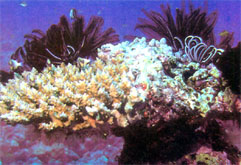
The islands are described as Coral Paradise because of scenic beauty. These
pres ent a breath-taking spectacle of sparkling coral reefs encircling a placid
and tranquil lagoon and palm covered tiny islands. These islands not only have
their wealth of natural beauty but also present spectacular variety of animal
and bird life Lakshadweep is India's only Coral Paradise.
The Lakshadweep group of islands lie on the northern edge of the 2500Kms
long North-South aligned submarine Lakshadweep Chagos ridge. The ridge is separated
from the Malabar shelf by the Lakshadweep Sea and merges with the shelf between
latitude 11 to 14. The ridge rises from a depth of 2000 to 2700 metres in the
Lakshadweep Sea and about 4000mts in the Arabian Sea. The eastern side of this
ridge appear to be steeper than the western. The ridge has a number of gaps, the
main being the Nine Degree Channel which separates the atoll of Minicoy from the
northern group of islands. On this extensive ridge a large number of atolls and
some large banks are situated.
All the islands are covered with white sand. A few metres under the sand on
all the islands; excepting Minicoy and Kalpeni, lies a horizontal bed of coral
lime-stone. The limestone is used for the construction of buildings. Plentiful
supply of potable water is available in this limestone layer. Fresh water can be
obtained by bore well through the limestone subtraction at an average depth of
two to three metres.
| ISLANDS |
ISLETS |
| 1. Viringili |
Utturubilla |
| 2. Cheriyan |
|
| 3. Kodithala |
|
| 4. Tilakkam (i) |
Titakkam (ii) & (iii) |
| 5. Pitti (i) |
Pitti (ii) & (iii) |
| 6. Bangaram |
|
| 7.Tinnakara |
|
| 8. Parli (i) |
Parli (ii) & (iii) |
| 9. Kalpitti |
|
| 10.Suheli Valiyakara |
Indira Dweep |
| 11.Suheli Cheriyakara |
Shastri Dweep |
| 12.Pitty (Bird Island)
Chetlat
Bitra |
Gandhi Dweep
Nehru Dweep |
Kavaratti
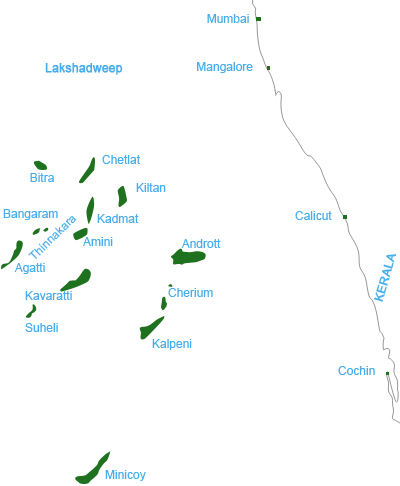
Kavaratti which is the headquarters of the territory, is situated at 10o33'
north latitude and 72o38 east longitude. It lies between Agatti and
Andrott but a little to the south and is 301Kms from Kozhikode. The island is
about 6kms in length and breadth is about one km. At the southern end,
the land shrinks to a width of 47 metres. The lagoon on the western side is
about 11/ 2kms wide.
The houses are concentrated within a small area and the compounds adjoin one
another. The narrow southern portion starting from where the inhabited part ends
is entirely government land. The government offices and the quarters for
officials are located in this area. This portion was once separated from the
inhabited are by a wall. Under the Bibi of Cannanore's administration (A.D.1764)
no islander was allowed to go south of the wall without a pass.
The people here are skilled as stone masons and wood carves and their mosques
are architecturally superior to those of the other islands. The Ujira Mosque
with its intricate carvings in wood is a fine example of the skill of the
Kavaratti craftsmen. The patterns are intricate, picked out in harmonious shades
of pale green and dark red, they are very effective. The Jumah Mosque is a large
building and possesses the largest tank of any mosque in the islands. The
headstones in the graveyards are in green or blue stain with Koranic texts
carved on them. These reveal delicate skill in stone carving.
Andrott
Andrott is situated at 10o49' North Latitude and 73o41'
east longitude. Andrott lies 198kms from Kozhikode. It has no lagoon and
occupies the whole of the atoll.
The island is thick with plantation of coconut trees which yield the finest
copra available in the territory. This is the only island where the plantation
has not intruded into the low lying areas in the middle of the island, where
rice was grown in olden days. There is no facility for shallow fishing, as there
is no lagoon. During the neap tides the small species of octopus are caught
which is considered a great delicacy.
According to popular belief this island was the first in the territory to
embrace Islam enbloc and retains the religious leadership. The Saint Ubaidullah
who is believed to have converted the islands into Islam died here and his tomb
still remains in the Jumah mosque. As a mark of respect to the saint the island
vessels passing the island repeat the Fathiha. The religious leader at Andrott
are regarded with respect on the west coast and even in Sri Lanka and Malaya.
Many of them go on Zafar to distant places, conduct prayers and give talisman to
cure both physical and mental diseases. The religious outlook of the people have
shaped their social outlook. Women are socially placed in greater seclusion
.
Amini
Amini is situated at 11o7' north latitude and 72o 44'
east longitude. It is about 3kms long and 1.6km wide. It is oblong and leaves a
very shallow all around. The island lies 304kms south-west of Mangalore.
Amini was one of the first to be inhabited. The nearby islands were
inhabited by people from this island and they were mainly tenants of the landlords
of Amini. There is a formation of coral sandstone sand stone on the eastern and
western beaches which is cut and used for building houses by the local people.
Since 1799 the island had been under the British and was the seat of the
Monegar, the officer in whom was vested all revenue and judicial functions.
Amini still retains its importance as the seat of the Tehsildar for the
Aminidivi group of islands. Vasco da Gama visited the island on his second voyage
and noted the superior quality of coir prepared by the islanders.
In a deal to secure the safe passage of the island vessels from the sea
pirates, the Portuguese Emperor demanded 1000 candies (1 candy 20 maunds) of
Amini coir every year in 1530. Having failed to secure this trade the Portuguese
established their authority on the entire Aminidive group by force. Sheikh
Zeinuddin records that the Portuguese slew a vast number of islanders and made
captives of more than 500 inhabitants. They burnt everything and greater part
of the mosque and houses.
In Amini there were talented craftsmen who can make beautiful walking sticks
with tortoise and coconut shells. The island is also known for its stone
engravers who carve beautiful flower motifs on hard coral stone. The people have
a rich tradition of folk song. The boat songs peculiar to the Aminidivi group
attaining its highest form in this island. The song sing of legends from Islamic
history and love themes and some themes are made extempore to praise a visiting
VIP or to depict a particular island situation. The songs begin at a low pace
and gather momentum as the oars strike the water more rapidly, adding to the rhythm
of the oars and gives a greater speed to the boat.
|