|
|

Friday, May 3, 2024
|
|


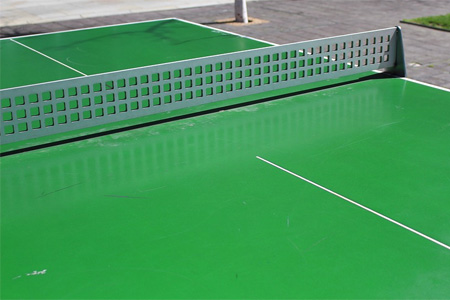
The table shall be rectangular, 2.74 m in length and 1.52m in width. It shall be supported so that its upper surface, termed the playing surface, shall lie in a horizontal plane 76 cm above the floor. It shall be made of any material and shall yield a uniform bounce of not less than 22cm and not more than 25cm when a standard ball is dropped from a height of 30 cm above its surface. The playing surface shall be dark-coloured, preferably dark green and matt with a white line 2cm wide along each edge. The lines at the 1.52 cm edges or ends, shall be termed 'end- lines' and the lines at the 2.74m edges or sides shall be termed 'sides lines'.
For doubles, the playing surface shall be divided into two halves by a white line 3mm broad, running parallel to the side lines, termed the center-line. The center line may be permanently marked in full length on the table and this in no way invalidates the table for Singles play.
The playing surface shall be divided into two courts of equal size by a net running parallel to the end lines. The net with its suspension, shall be 1.83 mm in length. Its upper part shall be 15.25 cm above the playing surface and its lower part shall be close to the playing surface. It shall be suspended by a cord attached at each end to an upright post 15.25 cm high. The outside limits of each post shall be 15.25 cm outside the side line.
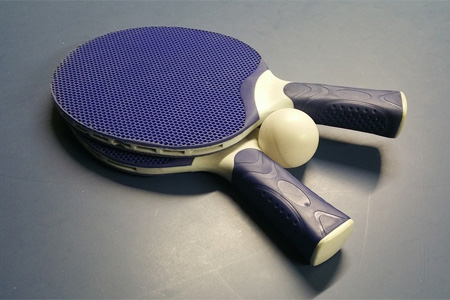
The racket may be of any size, shape or weight, but each side shall be uniformly dark coloured and matt. The blade shall be of wood of even thickness flat and rigid. Any trimming or binding round the edge of the blade need not be of the same colour as neither side but shall not be white, yellow or brightly reflecting. If a side of the blade used for striking the ball is covered, this covering shall extend over the whole striking surface. It shall be covered either by ordinary pimpled rubber with pimples outwards, having a total thickness including adhesive of not more than 2mm or by sandwich rubber consisting of a layer of cellular rubber surfaced by ordinary pimpled rubber with pimples inwards or outwards, having a total thickness including adhesive of not more than 4mm. If a side of the blade used for striking the ball is not covered, the wood shall be dark-coloured, either naturally or by being stained, not painted in such a way as not to alter the frictional characteristics of the surface. The part of the blade nearest the handle and gripped by the fingers may be covered with material such as cork for convenience of grip and is to be regarded as part of the handle. A side of the blade never used for striking the ball may be painted or covered with any material provided that the surface is uniformly dark-coloured and matt; a stroke with such a surface would be illegal and result in a lost point. Minor variations of shade, due to wear or ageing of the surface, should not be regarded as infringing the requirement for uniformity, which is intended to prevent the use of basically different colours on a single side of the blade.
|
|