|
|

Friday, April 26, 2024
|
|


|
|||
|
|||
|
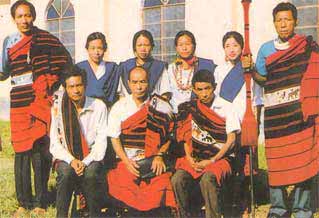
Dress The common pattern among the Angamis is red and yellow (now being replaced by green) bands, on black cloth called Lohe. The western Angami villages have their own distinctive pattern. Lothas have a streamlined gradation of shawls indicating the number of gennas performed by the wearer. Thus a man who has performed the first genna wears the phangrhup, its strips being widened, after the second genna. The third genna entitles the man to wear the Ethasu, while after the series of feasts is completed and the stone-dragging done the man can wear the Lungpensu, which is a dark blue cloth with five stripes of light blue and with narrow marginal stripes on each side. Among the Changs, the unmarried boys and girls wear the Kaksi nei, while the newly married couple sport the Silang nei. Another variety of Chang shawl, the Tobu nei has zig-zag patterns in alternate red and black on a blue band. The popular Yimchunger shawls are the Aneak khim which is black, and Mokhok khim which is white. Rongkhim, a particularly attractive variety of Yimchunger shawl, may be worn only by one who has taken heads in war, it has prominent rectangular red design, red colour signifying the blood of the enemy.
In the past it was possible to identify, by simply looking at the shawl of the wearer, the tribe he belonged to and occasionally even the group of villages he came from, his social status and the number of gennas he had performed. But nowadays this identification is not possible. Apart from the shawl, the normal working dress is a kilt which is generally of black colour. It may be embroidered with cowries in which case it is looked upon as a distinctly male dress. The cowries are rubbed on stone before being embroidered so that they may stick well, and they are always sewn by the man using the cloth and never by his wife or anybody else. The cowrie decoration is quite popular among the Nagas and it imparts to the kilt the character of toga virility, signifying his success in love or war. |
|||
|
||||||||||
|
||||||||||
Related Links |
| ▪ Classifieds |
| ▪ Education |
| ▪ Photo Gallery |
| Last Updated on : 27 July 2018 |


 The
most prominent item of Naga dress is the shawl. It is different for every
tribe and besides, there are varieties and sub-varieties in
every group.
The
most prominent item of Naga dress is the shawl. It is different for every
tribe and besides, there are varieties and sub-varieties in
every group. 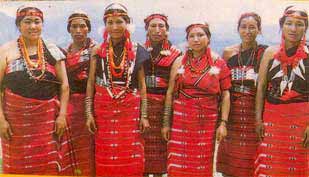 The
Ao warrior shawl called the Tsungkotepsu with figures of mithun, tiger,
elephant, human head, cock, Dao and spear is strikingly picturesque. Each
of these figures is symbolic; mithun represents wealth of the wearer,
the elephant and tiger denote his prowess in hunting and the human
head signifies success in taking heads. These patterns are painted in
black on a white band, while the cloth itself is of dark blue colour.
The
Ao warrior shawl called the Tsungkotepsu with figures of mithun, tiger,
elephant, human head, cock, Dao and spear is strikingly picturesque. Each
of these figures is symbolic; mithun represents wealth of the wearer,
the elephant and tiger denote his prowess in hunting and the human
head signifies success in taking heads. These patterns are painted in
black on a white band, while the cloth itself is of dark blue colour.