|
|

Sunday, May 11, 2025
|
|


|
|||||||||
|
|||||||||
|
Thiruvathira
Thiruvatira is the women's festival of Kerala. It is celebrated in the Malayalam month of Dhanu. The popular conception of this festival is that it is the commemoration of the death of Kamadevan; the cupid of our national mythology. 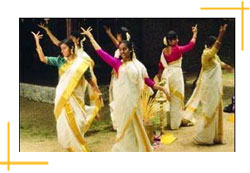
Then they proceed to On the festival day, they take a morning bath and in the noon a grand lunch is served. The essential ingredients of it is being ordinary ripe plantain fruits and a delicious preparation of arrow-root powder purified and mixed with jaggery or sugar and also coconut. The women spend the whole night singing and dancing.
Thiruvathirakali also known as Kaikottikkali is a dance in which a group of women dance in a circle around a lighted brass lamp. They are dancing to the rhythms of the songs they sing. They wear the traditional dress, consisting of two pieces, dhoti and an upper garment across the breast and look elegant and sprightly for the game. The leader of the group sings the first line which is repeated by the group to the simple rhythm of clapping hands. There are many songs which are exclusively sung as Tiruvathira songs, popular Kathakali songs are also included. The kinetic phrases are so simple that any new comer easily gets initiated to the game. This dance form had been keeping its basic posture for centuries. The bent of the body, hand movements and dance gestures are common to the region. 'Ettangadi chuduka' is an important ritualistic act of women. On this day, eight different tubers are roasted in the fire. Through this ritual, it is believed that Kamadeva's body represented by the tubers is regained. This delicious preparation known as Thiruvathirappuzhukku, a special dish prepared by these tubers forms the main item for lunch. In some places, women spend the whole day taking no food except this preparation. The night long music and dance is interspersed with a ceremony called Patirappoo choodal. It is a ritualistic wearing of flowers at midnight. An image of Shiva is placed in the centre of the courtyard in front of lighted brass lamp where flowers, plantains, and jaggery are offered to the deity. The women perform the dance around the image and each participant adorns a few flowers from the offering and have the arrowroot preparation of puzhukku and tender coconut milk, which are the items of the food. The morning bath during the season while the climate is extremely cold make the women's body cool and composed. Apart from the religious significance of the day, the women of Kerala enjoy good exercise and entertainment on this day. After the midnight, ritual of adorning with flowers, the dance and music continue till sunrise. The participants take the morning ablution and with it they conclude the festival. |
|||||||||


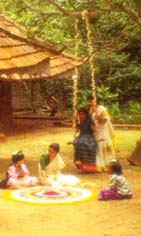 the enjoyment of another prominent item known as Oonjal (swing). A long
bamboo piece is taken and cut from the root end of it leaving the
other end whole untouched. Then the two holes are bored. One on the cut
end of each one of the two parts into which the bamboo is split. A small
piece of the same, material about a yard in length is divided along the
gain in two equal parts. One of these is taken and its both ends are cut
into points which are thrust into the holes of the long bamboo piece.
This is securely nailed and strongly attached to the long bamboo.
It is then hung by a very tight strong rope to a horizontal branch of
the neighbouring tree. Then the player seats herself on the small piece
attached between the split positions which are firmly held by her two
hands. The whole thing is propelled upwards by someone from behind. The
ladies drive immense pleasure from their process of swinging backwards
and forwards.
the enjoyment of another prominent item known as Oonjal (swing). A long
bamboo piece is taken and cut from the root end of it leaving the
other end whole untouched. Then the two holes are bored. One on the cut
end of each one of the two parts into which the bamboo is split. A small
piece of the same, material about a yard in length is divided along the
gain in two equal parts. One of these is taken and its both ends are cut
into points which are thrust into the holes of the long bamboo piece.
This is securely nailed and strongly attached to the long bamboo.
It is then hung by a very tight strong rope to a horizontal branch of
the neighbouring tree. Then the player seats herself on the small piece
attached between the split positions which are firmly held by her two
hands. The whole thing is propelled upwards by someone from behind. The
ladies drive immense pleasure from their process of swinging backwards
and forwards.