Bharatanatyam - Technique
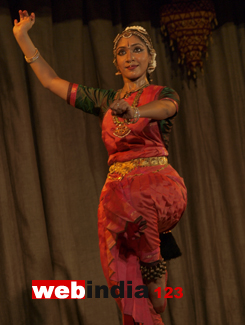 The next group known as the 'di di tai' has nearly 16 varieties
and is another example of the number of permutations and combinations which
can be woven around a basic movement executed to three beats. Certain varieties
of this adavu provide the climax to dance sequences or cadences known as the
tirmanams in Bhrartnatyam. This group, in its simplest form, is the use of the extended leg and its contraction. A typical example is the right leg extended front, the heel beating the ground,
followed by the left foot in place, stamping the ground. The right foot is brought
back to place in the third beat and stamps the ground in the ardhamandali position.
In another variety, the arms weave circular patterns in contrast to the straight
frontal ones of the lower limbs. The right hand, which is first extended in
front, gradually moves back to the shoulder level on its own side, while the
left hand goes back and by the turning of the waist, is brought over the head
and into a front-down position usually ending in the hasta known as the 'alapadma'.
The next group known as the 'di di tai' has nearly 16 varieties
and is another example of the number of permutations and combinations which
can be woven around a basic movement executed to three beats. Certain varieties
of this adavu provide the climax to dance sequences or cadences known as the
tirmanams in Bhrartnatyam. This group, in its simplest form, is the use of the extended leg and its contraction. A typical example is the right leg extended front, the heel beating the ground,
followed by the left foot in place, stamping the ground. The right foot is brought
back to place in the third beat and stamps the ground in the ardhamandali position.
In another variety, the arms weave circular patterns in contrast to the straight
frontal ones of the lower limbs. The right hand, which is first extended in
front, gradually moves back to the shoulder level on its own side, while the
left hand goes back and by the turning of the waist, is brought over the head
and into a front-down position usually ending in the hasta known as the 'alapadma'.
The eighth group is sometimes knows as the 'poi
adavu', meaning the soft silent
dance patterns, with graceful hops and jumps. While there are many varieties of
this adavu, its distinctive feature is the lifting of the feet very silently to
a new position. Such extensions, front and back, are common. Some of the jumps
of Bharatnatyam belong to this group. Portions of dance numbers such as
Jatisvaram are executed in this adavu.
The final and the ninth group is called 'ta dit dit tai'. Here the arms provide
variation while stamping in the ardhamandali remains constant. A combination of
this variety and the seventh group provides many complex, improvised patterns on
the basic tala.
A number of these adavus can be knit together to form sustained dance
sequences. These dance patterns are known as the tirmanams. The difference
between an adavu and a tirmanam is perhaps slight but a very real one. Actually
the word tirmanam is literally used for the rhythmic syllables spoken by
the dance conductor as he plays on the cymbals. The tirmanam is recited vocally
and has its own mnemonics (sollukattu). The adavus and the tirmanams are set to
the beats of a tala.
In a tala, certain beats are important and receive stress. In a tala called
the 'triputa' which may be expressed in terms of western music as the 7/4 the
metre, the first, the fourth and the sixth are stressed. The weaker beats are
counted only by the fingers or waiving the hand. In the most common adi
tala, which consists of eight beats, the first, the fifth and the seventh are
stressed.
The tirmanam can be performed either only on a drum (mridangam) or to a sung
melodic line. In the nritta portion, the dancer first performs these patterns
only to the beat of the drum and then as she proceeds, executes them to the sung
melodic line. An adavu is a Karana, a tirmanam a combination of adavus or an
anghara culminating normally in a triplet.
When Bharata Natyam adheres to tradition it brings the
artist and the spectator into contact with all that is best and purest in Indian
culture. It exalts the mind and refreshes the spirit. Bharata Natyam is amongst
the finest of our art treasures, the noblest of our inheritances.



