|
|

Saturday, April 27, 2024
|
|


| INTRODUCTION PERFORMANCE MUSIC, COSTUME AND MAKE UP TECHNIQUE DANCERS |
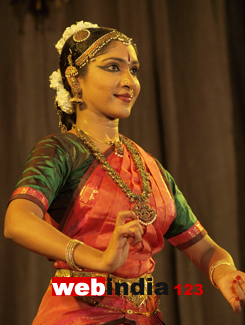 Bharata Natyam usually consists of Nrtya including Nrtta or pure dance and
Abhinaya or gesture play. The musical accompaniment is of the Karnatic school
with the tala or timing, predominating over the raga or melody in the nrtta
passages.
Bharata Natyam usually consists of Nrtya including Nrtta or pure dance and
Abhinaya or gesture play. The musical accompaniment is of the Karnatic school
with the tala or timing, predominating over the raga or melody in the nrtta
passages.
Alarippu
The Alarippu opens every Bharata Natyam performance. The name is derived from the Telegu word, 'alarimpu', meaning to decorate with flowers. The dance is a pure nrtta offering in double and treble rhythms, there being absolute harmony of movement between the head, the hands and the feet. Hands joined above the head, feet touching, the dancer begins with 'rechekas' or neck movements with the eyes and the hands acting in unison. The same 'rechekas' are later executed in a semi-seated posture, after which, rising, the dancer moves back to the starting position.
Jethiswaram
The Jethiswaram is the next number. It is a dance expression of the ideas and impressions evoked by musical sounds. The rhythm of the dance is set to one of five 'jethis' or time beats, which may be 3, 4, 5, 7 or 9. The time-keeper beats out the measure with his talas or cymbals, while the drummer produces a variety of fascinating sounds. The dancer adds to the cadence with his feet, preserving the tala. The chief effect of this number is a pleasing harmony of sounds.
In the later movements of the dance, the performer displays, with marked emphasis, the swarams or delicate nuances, which are pronouncedly beautiful in the Pillay technique based on the Kalyani, Bhairavi, Chakravagam, Todi Vasanta and Sankarabaranam ragas.
Sabdam
The third item is the Sabdam. It is an interpretative dance, expressing through abhinaya or mime, the purport of a hymn of devotion or a romantic lyric. While the Bhakti or devotional rasa predominates in the Sabdam, this dance can also interpret other rasas or sentiments. The Sabdam concentrates on abhinaya or acting and the feet play, a less important part than the hands and body.
Varnam
The Varnam which is the longest of all the dances is rather elaborate. In it, both nrtta or pure dance and abhinaya or acting play equal parts. Love is usually the theme of the Varnam. The dance ends in a furious tempo with quickly changing patterns of the feet and rapid 'thirmanams'.
The Todi Varnam, the Kalyani varnam and the Ragamalika Varnam are the three popular varieties of the Varnam. The dancer starts off on a slow tempo, assuming a series of poses which gradually quicken. Then come thirmanams or flourishes of the hands, getting faster and faster and the nrtta ends after several leaps and bends on three pronounced beats of the feet.
Then follows the abhinaya portion of the Varnam. The acting dramatizes a single theme in various ways according to 'sanchari bhava'. This variation of the Samcari or sanchari bhava lends warmth to the entire Varnam. The songs of Thyagaraja, Jayadev, Kshetrajna and Arunacalakavi lend themselves well to this mode of interpretation.
Padams
Songs expressed in mime are known as Padams. In 'Padam' the dancer performs the act of lovers in various poses. Many famous music composers like Kshetrajna, Jayadevan, Gopalakrishna Bharati, Swathi Thirunal, Erayimman Thampi etc have composed Padams which complements the dances. Three to four Padams are performed on stage.
Thillana
The Thillana is the last number on the programme. This is a foreign element that has crept into Bharata Natyam. It is derived from the ragas of North Indian Ustads or composer teachers and has existed in its present form. The Nattuvans wove Thillanas into the existing South Indian dance fabric.
Thillana have pure nrtta in different talas. The variety known as 'Chilakottu' is usually danced to the adi tal or eight beat rhythm while that known as 'Kaikalakottu' follows double timing or four times the regular beat. The dance is set to one of several ragas including the Sankarabaranam, the Kafi, the Todi and the Kannada.
Some famous dancers like Bala Saraswathy, Mrinalini Sarabai, Rukmini Arundel, Padma Subhramaniam, Vaijayantimala, Chitra Visveshwaran etc have given great contributions to promote Bharatanatyam. Some of the famous Nattuvans are Pandanallur Chokkalingam Pillai and Adayar Lakshmanan.
CONNECT WITH DANCE |
||||||
|
||||||
Watch Video |
| Classical Dances | ||||||||||||||
|
| |
Dance Videos |
| MORE |
Dance Institutes |


