|
|

Friday, May 3, 2024
|
|


|
|||||||
|
|
|||||||
| Cultural Complexity
In the days of Rajput supremacy, life centred round the courts in the capital towns of the erstwhile states and the feudal castles and fortresses in the countryside. The Brahmins who were the conscience-keepers of the Rajput rulers, form a significant section of the population. They have retained religious fervor at a high peak in this land of valour and chivalry. The Jains too have raised some of the best specimens of religious architecture. The Jains, Brahmins and the Vaishyas are purely vegetarian, while Rajputs, the Kayasthas, the Gujjars, the untouchables and the tribals are all non-vegetarian. The girls of Daroga community used to form part of the dowry of the daughters of the Rajputs and the community on the whole lived in semi slavery. Neo-Muslims or Kaimkhanis and the Meos retain many of their original Hindu customs. They call both the Kazi and the Pandit to solemnize a marriage or nikah and celebrated Hindu festivals. Lying between the land of Krishna's birth, the Krishna cult had an intense impact on Rajasthan but the Dadupanthis, Ram-Sanchi, Laldasi and Vishnoi sects follow their own religious norms and ways of worship. |
|||||||


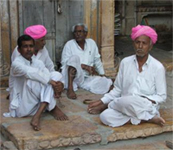 Cultural complexity is a mixture of many cultures and civilizations which
is fundamentally strong in its indigenous traditions. Primitive and aboriginal
customs intermingle with feudal sophistication and courtly manners. Tribal
democracy, ruthless autocracy, benevolent despotism, polytechnic skills,
business acumen and industrial enterprises have all contributed to make
the social and
cultural fabric of Rajasthan.
Cultural complexity is a mixture of many cultures and civilizations which
is fundamentally strong in its indigenous traditions. Primitive and aboriginal
customs intermingle with feudal sophistication and courtly manners. Tribal
democracy, ruthless autocracy, benevolent despotism, polytechnic skills,
business acumen and industrial enterprises have all contributed to make
the social and
cultural fabric of Rajasthan. 