| Music
 Music
and dance are two very important aspects of the folklore of any region.
In Rajasthan, songs play a dominant role in the life of the people. The
lyrics are read in a prosaic style. They are not strictly songs and are
referred to as duha, soratha etc. Songs, which are more poetic than musical
or melodious are called folk poetry. Music
and dance are two very important aspects of the folklore of any region.
In Rajasthan, songs play a dominant role in the life of the people. The
lyrics are read in a prosaic style. They are not strictly songs and are
referred to as duha, soratha etc. Songs, which are more poetic than musical
or melodious are called folk poetry.
The real folk-song is not something
to be read. The words of folk-song become meaningful when they are saturated
with the rhythm of music to which they have been spontaneously set through
continuous use by the people. This make folk songs timeless and limitless.
Folk songs, deal with domestic or family affairs, seasons, festivals,
rituals and customs.
Gorbund is a famous folk song which describes the
process of preparing a decorative string for a camel, Rajasthan's traditional
mount. The song express the beauty in innocent labour. The composition
is particularly moving when sung to the rhythm of Kaharwa. The enjoyment
of this song is hundred percent when sung to this raga. The other folk
songs are 'Indhani', 'Lawarji', 'Jallo', 'Hichaki', 'Olyun', 'Sapno',
'Kurjan' etc. The tunes of these song are melodious and fast that even
the rendering of their first times over a stringed instrument makes the
audience ecstatic.
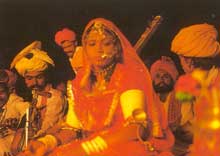
Rajasthan has a number of communities whose hereditary
profession is to sing for the entertainment of others. Among them are
the Dholis (both Hindus and Muslims), Dhadhis, Mirasis, Mangamars, Fedalis,
Kalawats and Qawwals, Tangas, Patars and Kanchari (Hindu and Muslim prostitutes),
Nats, Rawals and Bhawais. These communities have contributed to the preservation
and popularisation of Rajasthani folk songs.
|