|
Among the innumerable festivals that take place all over Kerala, almost
all the prominent ones are connected with religious institutions. The
Utsavas of the Hindu temples and the Perunals of Christian and Muslim
churches are of utmost importance to the community. There are certain
festivities like the boat races, which originated to commemorate religious
events but subsequently turned out to be events of social importance.
Navaratri
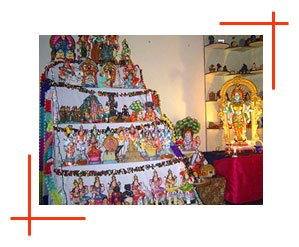 This is the Durga Puja of Bengal, Dussera of Bombay and the Saraswati
Puja and the Ayudha Puja of the south. Its entire course runs over 9 days.
It is the last three days that are most important. These are known as
Durga Ashtami, Mahanavami, and Vijaya Dasami. On the night of the Durga
Ashtami day, there is the ceremony known as 'Puja Vayppu'. It consist
in decorating a room splendidly, illuminating it with many lights and
arranging on a platform, raised in the middle of the room, the things
necessary for doing Puja to Saraswati,
the goddess of learning. Books and weapons of various kinds are tastefully
arranged and a picture or image of the goddess placed in the centre. The
worship then commences with accompaniment of music. This goes on night
and day till the morning of the third day, when the 'Puja Eduppu'
or breaking up of the Puja takes place. After the performance of special
religious service, the arrangements on the platform are formally removed
and the Puja broke up. Then follows the 'Vidyarambham' or the beginning
of learning. On the last three days of Puja, all sorts of learning are
kept in abeyance; no one will read or write or do any handicraft or work
with any material. Every sort of business is at a stand still. After the
Removal of Puja, work commences. During the Puja Vayppu people generally
fast.
This is the Durga Puja of Bengal, Dussera of Bombay and the Saraswati
Puja and the Ayudha Puja of the south. Its entire course runs over 9 days.
It is the last three days that are most important. These are known as
Durga Ashtami, Mahanavami, and Vijaya Dasami. On the night of the Durga
Ashtami day, there is the ceremony known as 'Puja Vayppu'. It consist
in decorating a room splendidly, illuminating it with many lights and
arranging on a platform, raised in the middle of the room, the things
necessary for doing Puja to Saraswati,
the goddess of learning. Books and weapons of various kinds are tastefully
arranged and a picture or image of the goddess placed in the centre. The
worship then commences with accompaniment of music. This goes on night
and day till the morning of the third day, when the 'Puja Eduppu'
or breaking up of the Puja takes place. After the performance of special
religious service, the arrangements on the platform are formally removed
and the Puja broke up. Then follows the 'Vidyarambham' or the beginning
of learning. On the last three days of Puja, all sorts of learning are
kept in abeyance; no one will read or write or do any handicraft or work
with any material. Every sort of business is at a stand still. After the
Removal of Puja, work commences. During the Puja Vayppu people generally
fast.
In Travancore the Navaratri is a state ceremony
celebrated with great magnificence. During the old times in Padmanabhapuram,
all gates of the city were beset with soldiers, and no one was allowed
to go out or enter. The festival continued for eight days, and when it
was over, the king distributed presents to Brahmans. Each received a rupee.
The high priest presented to the king a Vastram; which is a piece of silk
or cotton stuff, a Viraghen; worth about three scudi and a cow as the
support of life because these people lived chiefly on milk and butter.
Such a present is called Godanam. It is said that there is no evidence
for that the Godanam or gift was made to the king by the high priest.
The gift must have been made by the king to the high-priest.
On Vijay Deshami day the Maharaja goes in state accompanied
by the state officers and escorted by the military to a place called Pujappura
a couple of miles from the fort at Trivandrum and shoots an arrow into
consecrated tender coconut placed for the purpose. After this the procession
returns and his highness standing in the Verandah of the 'Karivelappura
Malika' in front of the Trivandrum temple strews money amongst the crowd
collected below.
|



