Situated about 65km SE of Junagarh district in the state of Gujarat in
South West India, the National Park was established on 18th September,
1965, as a Forest Reserve, primarily to conserve the Asiatic lion-classified
as one of the World's most threatened species. Now Gir National Park is
the only remaining place in the world, where one is likely to see the
Asiatic Lion. The sanctuary covers a total area of 1,412 sq. km of which
258 sq.km at the core forms the National park. Permits are required to
enter this part of the sanctuary.
The land is rugged with deep ravines, steep rocky hills
and plenty of rivers. The vegetation, mainly along the main rivers and
streams is mixed deciduous, with Teak, Acacia, Jamun, Tendu and Dhak trees,
interspersed with large patches of grasslands and offers the visitor long
pleasant drives, through the thick forest cover. These trees are mostly
broad leaved and evergreen, giving the area a cool shade and moisture
content. The Gir forest is dry for most of the year with scrub trees,
like babul and few flowering trees. Prosopis and Casuarina have
been planted in the coastal border as part of the aforestation plan.
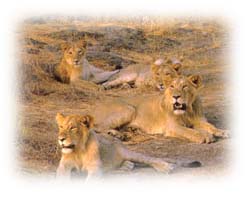 The
Asiatic lion once had a wide range in natural territory running from NW
India through Persia to Arabia. But unfortunately hunted as a coveted
trophy item during the British Raj era, it is now only found in the Gir
forest of Gujarat. The famine of 1899 so decimated the Asiatic lion population
that Lord Curzon cancelled his shoot at Gir, where he was staying as the
guest of Nawab Junagadh. Curzon persuaded the Nawab to protect the remaining
lions. In 1965, the India Government declared this place as a National
park. The lion population which had sunk to an alarming two dozen in the
early 20th century has slowly climbed over the years since, and now numbers
about 300. The
Asiatic lion once had a wide range in natural territory running from NW
India through Persia to Arabia. But unfortunately hunted as a coveted
trophy item during the British Raj era, it is now only found in the Gir
forest of Gujarat. The famine of 1899 so decimated the Asiatic lion population
that Lord Curzon cancelled his shoot at Gir, where he was staying as the
guest of Nawab Junagadh. Curzon persuaded the Nawab to protect the remaining
lions. In 1965, the India Government declared this place as a National
park. The lion population which had sunk to an alarming two dozen in the
early 20th century has slowly climbed over the years since, and now numbers
about 300.
Within the sanctuary, there are numerous human settlements
of cattle herders called Maldharis. There are also places of Hindu worship
and pilgrimage and sulphur springs at Tulsi Shyam and Kankai Mata. At
the edge of the park there are good populations of Indian Gazelle, protected
by the religious sentiment of the local people.
|



 Wildlife


 NEXT
NEXT
