Home Site Map Make Your Home Page Suggestions Enquiry Advertise With Us
 
Indian States and Union Territories

Himachal Pradesh

     Land
     History
     People
     Festivals
     Economy
     Arts
     Crafts
     Tourism
     Tell A Friend
     Feedback

Metro Cities

ARTS 

Dances | Music | Folk Arts | Theatre

DANCE - Introduction | Mala Dance | Demon Dance | Dalshone and Cholamba Dances | Nagas Kayang | Jataru Kayang | Shan and Shabu Dances | Keekali and Bhangra | Nuala | Nati | Jhoori, Gi, Swang Tegi and Rasa Dances | Khaydayat and Lamba Dances | Lahadi and Ghooghati Dances | Dand Ras and Dangi Dances


Keekali and Bhangra

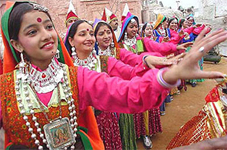
The Keekali (Kikli) dance is a dance of young girls and is danced playfully in twos. The girls hold hands crosswise and rotate fast on their toes, singing songs.

The Bhangra is a male dance which originated in Punjab and is popular in the Kangra, Himirpur and Una areas in a fairly wild form.Dance of Kangra

Rituals such as Chandroli, Jhumakada and Googa swang also give one a glimpse into the local dance forms.

The tribal dances of the trans-Himalayan region are different in content and music. The old tradition of both song and dance in these areas has been zealously guarded against any urban influence. The districts of Kinnaur, Lahaul and Spiti and Tehsils of Pangi and Bharmour of Chamba district constitute this zone. The inhabitants in these areas are known as Kinnauras, Lahaulas, Spitians, Pangwals and Gaddis. There are the Gujjars who are the wandering nomads. All these tribes have their own distinct traditions of folk-dances, songs, dresses and ornaments.

Besides the popular dances like Kayang, Bakayang and Banyangchu there are ritual dances performed by Lamas on certain religious ceremonies or festive occasions. One masked dance particularly features an important event in the history of Himalayan Buddhism when Lamas successfully carried out a plan of executing a cruel king Langdarma. A special occasion for masked dances is the celebration of the birth of Padma Sambhava who is held in high esteem by the Buddhists of Himalayas since it was he who carried the message of Buddhism to Tibet.

In the sword dances of Kulu, men dancers dressed in the traditional tight white trousers and tunics with bright bordered shawls and black plumed caps decorated with blue primulas and yellow jasmine. The women dancers wrapped in woolen shawls wearing their colourful headgear (Dhatu) enter the arena. Forming a circle and holding a handkerchief in the right hand men and women wave it as they move round and round in slight change and there are four steps taken with a pause in the fifth and three  more steps with the flat of the foot. Then suddenly two or three dancers come into the centre of the circle and commence dancing with brandishing swords. The dance is accompanied by dholak, Ran Singha, Karnal and small Clarionets.

Nuala

Nuala is a folk dance of the Chamba valley. In this a garland is placed upon a pedestal as Shiva's garland and around it many dance dramas depicting scenes from the life of Lord Shiva are enacted. Women possessed of evil spirits are also brought to these gatherings and their antics also add to the general mystery and awesomeness of the spectacle along with the heady fragrance of the incense and the beating of the drums. The chief devotee, Chela, of Shiva dances in a trance and answers questions that are put to him. He predicts dire changes and natural calamities which sends shivers in the crowds and people vow to offer special Puja if these are warded off by the gods.

Nati

Several forms of Nati dance are prevalent in the Kulu, Sirmaur, Mandi, Mahasu and Chamba areas. In Kulu this is known as Siraji Nati. It is like the Kathak dance and embraces a number of dances like Dheeli, Dekhi, Feh, Bakhali, Kahika, Dohari, Lahauli, Chambiyali, Banthada and Loodi. Rhythm is the main feature of this dance. The instruments that accompany this dance range from Drums, Shehnai, Cymbals and Ranasinga (an instrument similar to a trombone). The Shehnai played by the Hesis is the life of the Nati dance. It not only provides a rhythm but also puts life into the entire performance.

The Nati is not a dance for professional dancers but is open for participation by all age groups. It is a slow-moving dance from Lasya variety and lasts through three or four days and nights. The costume for this comprises of Chola (top coat), Ghaghra (skirt), Gachi, Lachhi, a floral shawl and Boomani with silver chains, tight churidar pyjamas, socks and shoes. The women wear heavy armlets and silver and gold ornaments known as Tunki and Chanki around their necks. The men and women hold an ornate fan in one hand and a colourful handkerchief in another and clap as they dance. Earlier the men and women danced separately but now they dance in unison.

[Back]

[Continued]


Quick Links - Webindia123.com
Services
Hobbies
 
Entertainment
Classifieds
Career / Education
UK, USA, Canada
Utilities
E-Booking
India Reference


IndianStates


Pradesh

Copyright 2000- Suni Systems (P) Ltd.
All rights reserved