|
The observance and celebration of feasts and festivals constitute the joyous
aspect of the religious life of the people.
According to the Shalivahana
(Saka) era followed in Goa, the New Year of the
Hindus is heralded by the 'Sonvsar Padvo' (Samvastsara Padva) meaning
Chaitra Shudh Pratipada. The day begins with a flag-pole being installed in
front of the house and munching of leaves of bitter lime, sweet eatables being
prepared for mid-day.
Chovoth or
Ganesh
Chaturthi
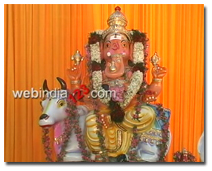
The most important and almost the national festival for Goan's
is the Ganesh Chaturthi known as 'Chovoth '.
The festivities run into several days, at least two and half days, when
puja of Gouri and
Mahadev along with
Ganapati, is performed,
Gouri being drawn on paper and Mahadev on a coconut. On these days married
women fast. On the Chovoth day, in the morning or evening, a clay idol
of Ganapati is brought home. Before that a matov (pavilion or pandal)
is prepared with bunches of betel nut, coconut, bananas and branches of
mango-trees being necessary ingredients of it. The puja of Ganapati goes
on until mid-day. The puja is performed with the help of the priest.
On the second day, in the evening or at night, after performing the uttara
puja of the image of Ganapati, it is taken in procession and immersed into the
sea, creek, river, lake or well. Before the idol is removed from its stand for
immersion, it is besought for the welfare of the household and its members.
Three days of Chovoth means, days of great rejoicing for children. Girls
collect different types and shapes of leaves for Gauri, Mahadev and Ganapati.
There is competition in flower-making also. At least five vegetables are cooked
on that day. Aartis is a special performance on the occasion of the
Ganapati festival.
On Panchami (fifth) day, in the evening, crowds of people
move around the village to have a look at Ganapati. Women of the masses,
dance and sing the Fugdi before Ganapati. Some houses keep Ganapati for
five, seven or nine days and rarely up to Anant Chaturdashi.
Top
Dussera or Dosro
Dussera or Dosro in Konkani comes following the
'Navaratra' (nine
nights) and is celebrated in all the temples of Goa as a religious ritual and an
auspicious day for beginning any new venture. It is celebrated on Vijayadashmi
day. It is celebrated with pomp and ceremony at the major temples of Goa, like
Shri Shantadurga at Kavlem, Shri Mangesh at Mangeshi, Shri Mahalsa at Mardol.
Diwali
or Narak Chaturdasi
Following the Dosro, comes Diwali which is the festival of
lights. It is a one-day festival in Goa. Bhaubija and the New year day
are also celebrated as part of Diwali festival. Narak Chaturdasi is called
Diwali in Goa. On this day, early morning, a paper made Narkasur (demon)
filled with grass, wastepaper, crackers etc is taken out and to the accompaniment
of taunts and insults, burnt and cremated. Later, in all the houses, bath
is taken. Women prepare various types of fov (dried beaten rice dusted
with sugar or jaggery and wetted lightly), raitas, usol and other snacks
and serve them. After the snacks are served, all men-folk are made obeisance
to by a gesture of showing a thali (plate) with lighted wicks around
their heads (onvalop) which is known as 'dive darkhovnk' in Konkani. The
men folk are expected to place some article or cash as a present in this
plate. Later after breaking a bitter gourd, crushed by the finger of the
left foot, it is applied to the tongue. Sweet snacks are taken, after
making obeisance to the God and the elders.
Top
Shigmo
Shigmo
is a social festival with a religious core. It is the Goan counterpart
of the Holi in the rest of India. On the Holi day, Puja is performed of
the stems of the teflam fruits or betel nut, struck on the ground before
the temple and a little grass put at their feet is then burnt. There are
a number of dances which burst forth on this occasion in the spirit of
plenty that marks the harvesting season when the barns are full
and a sense of satisfaction and mirth is bubbling all around
Gokulashtami, Mahashivratri and Brahmotsava are celebrated
at the temples of Goa with great splendour, when thousands of devotees
from all over Goa gather to pay homage to the deity. A famous fair known
as Jatra festival is held in the temple of goddess Lairai, situated in
the village of Sirigao in Bicholim taluka where thousands of people from
all over Goa come to pay their homage to the goddess. A special feature
of this Jatra is walking on burning coals by certain devotees
of the goddess popularly known as Dhonds.
Top
|