|
Naturally since paper will burn, certain precautions are necessary. Choose only materials tested and if you have never wired a lamp before, get advice from an electrical supply store or from a licensed electrician.
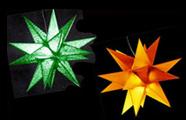
The star lamp shade here is based on a geometrical model of a simple icosahedron, a solid figure with twenty faces of three sides each. Pyramid star points are glued to the sides of an icosahedrons cut from two ply Bristol board or heavier paper. Holes are cut in the icosahedrons and covered with tissue paper. Since the light is filtered through two layers of tissue paper, the resulting effect is diffuse and glowing.
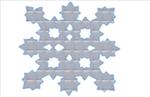
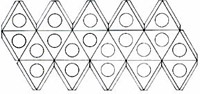
Pattern for an icosahedron-based star lampshade. Cut the pattern from two-ply or heavier paper. All the sides of the triangle should be equal. Say 2.5cm or 5 cm each and so on. |
 |
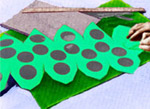 |
Cut out circles and cover the shape with tissue paper to filter the light. The figure is then drawn up and glued into its finished shape. |
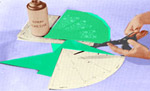
To make the pyramids, cut out quarter circles from dark colour tissue paper and as shown in the figure, and glue to a second sheet of lighter colour tissue. |
 |
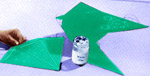 |
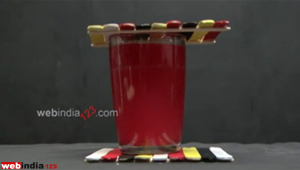
Glue on wooden dowels to form three triangles and shape to form a pyramid. Twenty such pyramids are needed for a star. Dowels can be bamboo skewers, tooth picks or medical applicator sticks cut to size. The Pyramid star points are glued at their bases, to the sides of the icosahedron shape, one pyramid occupying each triangle. The figure is then drawn up and glued into its finished shape to make the star shade. One of the pyramids is left unglued on two sides of its base so that the shape can be opened to admit a small light. |
|