|
|

Sunday, April 28, 2024
|
|


Cities & Towns  Karnataka
Bangalore
Destination
Parks, Gardens and Zoos
Lalbagh Botanical Garden
Karnataka
Bangalore
Destination
Parks, Gardens and Zoos
Lalbagh Botanical Garden
The entrance to the garden is marked by an equestrian statue of Raja Chamaraja Wodeyar of Mysore. The park has a huge collection of famous botanical species; tropical, sub tropical and medicinal plants. Apart from fountains, lotus pools, terraces and a deer park, it also houses the office of the Karnataka Horticultural Society.The main attraction here is the magnificent glass house, with jewel-like embellishments on gracefully curved and sloped geometric forms based on London Crystal Palace. It was originally built in 1888 by the English architect John Cameroon, with materials shipped from Glasgow in Scotland. The glass house was recently remodeled by incorporating more than 3,000 sq m of laminated glass. The illuminated glass house at night is a stunning sight. Another popular draw is the giant floral clock, surrounded by snow white and the seven dwarfs. The clock dial measuring 7 meters in diameter has been decorated with multicoloured flowers. The rose garden near the north gate entrance contains 150 different varieties of roses. The rocks at the garden is one of the oldest rock formations in India which is believed to be 3000 million years old. Lalbagh is the venue for flower shows held every year in January and August on the occasion of the Republic Day and Independence Day celebrations. The garden is open daily from sunrise to sunset. |
Nearby Attractions |
||||||||||||
|
Picture Gallery |
|
|
|
|
City Map |
|
Read
Review / Comment |
|||
By : Sachu 
|
|||
| Apr 1, 2010 2:36:56 PM | chennai | Reply to this Comment/ Review | ||
Nature lovers delight.... |
|||
|
||||||||
|
|
|||
POPULAR DESTINATIONS |
|||


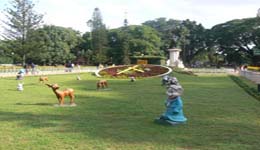 The famous Lalbagh Botanical garden, at Lal Bagh Fort Road, lies on the
southern fringes of the city. The superb 240 acre garden was laid out
by Hyder Ali in 1760 and his son Tippu Sultan added a wealth of plants
and trees from many countries. It was originally called Lalbagh because
the garden had a profusion of red roses.
The famous Lalbagh Botanical garden, at Lal Bagh Fort Road, lies on the
southern fringes of the city. The superb 240 acre garden was laid out
by Hyder Ali in 1760 and his son Tippu Sultan added a wealth of plants
and trees from many countries. It was originally called Lalbagh because
the garden had a profusion of red roses.
 Watch Video
