|
Karni Arni Mata Fair
The shrine of Karni Mata at Deshnok in the Nokha tehsil of Bikaner district
is the venue of a fair twice a year.
Both these fairs are held in
Navaratra, the first in March-April and the
second, which is smaller , in September-October. Deshnok is said to have
been founded by Karni Mata in 1419. There is a legend behind the Karni Mata Fair. Karni Bai was a strange girl
with mysterious power. As she was the sixth girl in the family, her aunt wanted
to cause her harm but the woman's arm was dislocated. At the age of five, Karni Bai cured her aunt's arm and her father who was bitten by a snake. She
helped people with her supernatural powers. On her way to Sind to meet her sister, Karni Bai met a blind carpenter at
Jaisalmer. She asked him to make a wooden statue of her and rest his head on it
when he lay down to sleep. The carpenter did so and found himself transported to
Deshnok the next morning, where his sight was restored. Karni Mata is said to
have died in 1538 and she has been worshipped as a goddess since then.
The temple of Karni Mata contains a 75 cm image of the deity. It is built of
the yellow marble found in Jaisalmer. There is a mukat or crown on the head of
the image and Karni Mata is shown weaning earnings.
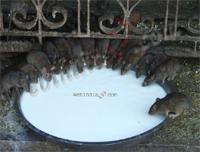
The temple of Karni Mata has been described as the temple of nice who roam
freely about the shrine, unconcerned by the devotees who throng there. If
anybody reads on a mouse and kills it, in repentance he has to present a silver
mouse at the temple.
Kapil Muni Fair
The Kapil Muni fair is held every year on Kartik Purnima in Kolayat which is
a sacred place near Bikaner. The word 'Kolayat' is derived from the Sanskrit
word Kapilyatan.
Kolayat is located on a plateau which is part of Thar desert. Here a deep
depression forms a lake where water is sweet and pure. The lake has fifty-two
ghats. A statue of Kapil Muni has been installed at the main ghat.
According to the Skanda
Purana, who was married to the daughter of Maharshi
Manu. Kapil Muni attained the highest religious merit in boyhood and taught his
mother the Sankhya Sastra. On his retirement to the Himalayas Kapil Muni came
across on oasis and was bewitched by its beautiful surroundings. A part of his
soul lingered there and oasis became famous and many devotees thronged it. But
the gods became jealous and hid it in the sandy desert. Skandh Deo, the son of
Siva and Parvathi, took pity on suffering humanity and brought the place back to
light. Great significance is attached to a dip in the holy lake which is supposed
to Purge the devout of his sins.
There are many legends connected with the area, which tell of rebirths and
vows made and broken and of rishis and munis who faltered and were saved.
Through the centuries a number of miracles are said to have been performed due
to the intercession of Kapil Muni. This belief still lingers to keep the fair
going.
Banganga Fair
The Banganga Fair is held near a rivulet about 11km from
Bairat, a historical
township in Jaipur district. People come on the full moon day of Vaisakh to have
a dip in the sacred stream which is supposed to have originated from the sport
where Arjun shot an arrow.
The fair ground is surrounded by low hills and has an abundance of palm
trees. The origin of the fair is shrouded in mystery. The fair started about 200
years ago, when the Radha-Krishna temple was erected. No feasts are held in the
temple and the pilgrims bring their own food. The banks of the Banganga are studded with temples. Besides the
Radha-Krishna
temple, and by the side of the Nand Kund, is the shrine of Hanuman. Maharaja
Ram Singh built the Har-Ki-Pauri. People gather at the temple a day before the
fair starts and sing bhajans at night.
The
Radha-Krishna temple is an impressive double
storey building. After ten
steps, there is a shrine of Garuda facing the main idols of Krishna and Radha.
On the four sides are Verandahs. One of them has the images of the Pandavas and
their wife, Draupadi. In the right verandah is a row of lingas on which water flows
through a common channel. One of the lingas has five faces carved on it. This is
known as the Panch-Mikhi-Madhaeva of Ekdash Rudra.
|