| .jpg) As per 2011 Census, the population is 64,429with literacy rate. People here are ethnically similar to that of the people of Kerala. A special
feature of the social set up of the territory is the division of the population
into various classes, viz. As per 2011 Census, the population is 64,429with literacy rate. People here are ethnically similar to that of the people of Kerala. A special
feature of the social set up of the territory is the division of the population
into various classes, viz.
Koyas, Malmis and Malacheris in Laccadive group
of Islands; Manikfans, Thakurs and Raveries in Minicoy and Tarwad, Tanakam-pranaver,
Kudiatis and Melacheris in Amini.
Koyas
The Koyas were the chief land owning class of the society. Formerly they were
known as Tarawadis or the Karnavar class. Originally, the class consisted of the
Principal families of Tarwads known as Karnavans who sat as jurors in the
community Panchayats. They regarded themselves superior to others and hated
alliance with others. In earlier days, the Karnavans were the real masters of
the land.
Malmis
The Malmis are the sailors. The word Malmi is connected with the signs of
ways. In the past the Malmis were the tenants of the Koyas and they served as
sailors under them and exported their produce in the odam. Piloting of vessels
is not the only privilege of this class and anybody who acquired mastery over
the nautical table is as competent as a successful Malmi.
Melacheris
The Melacheris were the original labour class of the islands and formed the
major part of the population of Amini of the Laccadive Group of islands. The
people of Kadmat, Kiltan, Chetlat and Bitra are all Melacheris who have migrated
from Amini and from the coast. Their traditional occupation is to collect
coconut tree nuts and tap neerah, the sweet toddy. It appears that the name has
its origin in their traditional place of residence on the western side of the
island. Mala means West, Cheri denotes a village.
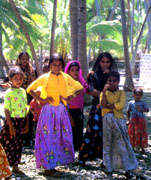 Among the class system of Minicoy, the Manikfans are considered to be of the
highest class. They alone owned private property and were the leisured class.
The Thakrufans were the sailors who mainly piloted sailing vessels. Takrus
worked in the boats during voyages while the Raveris were the Labourers. Women
of the four classes are known as Manikka, Beefan, Beebee and Kambilo
respectively. In between Thakrufan and Thakru , there is a sub-caste known as
Bebe. Among the class system of Minicoy, the Manikfans are considered to be of the
highest class. They alone owned private property and were the leisured class.
The Thakrufans were the sailors who mainly piloted sailing vessels. Takrus
worked in the boats during voyages while the Raveris were the Labourers. Women
of the four classes are known as Manikka, Beefan, Beebee and Kambilo
respectively. In between Thakrufan and Thakru , there is a sub-caste known as
Bebe.
In Amini, the class groupism appears to have been based on property. The
tarwad class comprised a few families which alone had tenants in the days of
early settlement. The Tanakampranavar were those possessing property of their
own but with no tenants under them. The Kudiyatis were the tenant class. The
Melacheris were originally the landless Labourers.
|