|
|

Saturday, April 20, 2024
|
|


| Hinduism | Hindu Gods and Goddess | Punniya Grandhas (Sacred Texts) | Sacred Places |
Ganapati
|
The trinity | Vedic Gods | Incarnations of Vishnu | Ganapati | Lakshmi | Parvati | Saraswati | Subrahmanya |
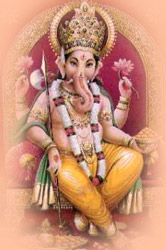
Ganapati or Ganesa, also known as Vinayaka is the son of Siva with face like that of an elephant. He is the most popular of the Hindu deities worshipped by all sections of the Hindus. He is considered as the god of good beginnings and clearer of obstacles (vigneswar). Hence, before starting any undertaking he is worshipped.
 The
most commonly accepted form of Ganapati depicts him as red in colour and in a
human body with an elephant's head. Puranas contain 2 different stories as to
how Ganapati happened to have the elephant's head. According to one story,
Ganapati lost his head when Parvati pointed out to
Ganapati the planet Saturn, and his head got burned down due to the ocular power
of Saturn. Ganapati's head thus lost was replaced
with that of an elephant. In the other story, it is said that Ganesh
was the creation of Goddess Parvati,
who breathed life into an image made of clay. She placed the image outside the
door while she was bathing and ordered him not to allow anyone to enter. Then
her husband Lord Shiva arrived and Ganapathi with the help of a single clothing
obstructed Shiva from entering.
The
most commonly accepted form of Ganapati depicts him as red in colour and in a
human body with an elephant's head. Puranas contain 2 different stories as to
how Ganapati happened to have the elephant's head. According to one story,
Ganapati lost his head when Parvati pointed out to
Ganapati the planet Saturn, and his head got burned down due to the ocular power
of Saturn. Ganapati's head thus lost was replaced
with that of an elephant. In the other story, it is said that Ganesh
was the creation of Goddess Parvati,
who breathed life into an image made of clay. She placed the image outside the
door while she was bathing and ordered him not to allow anyone to enter. Then
her husband Lord Shiva arrived and Ganapathi with the help of a single clothing
obstructed Shiva from entering.
Shiva became furious and severed the head of the idol. Parvathi was very upset over the incident as she considered the idol as her son (manas putra). To make amends Shiva ordered his servant to go and bring the head of the first living being he would meet. The servant saw an elephant, and he at once cut his head and took it to Shiva. Shiva joined the elephant's head to the body of Parvati's son. Thus Ganapathi came in to being. Out of the two tusks, one is broken. He has four arms. Two of the arms hold the pas (noose) and Ankusa (goad). The other two are held in the Abhaya and Varada Mudras. The belly is of generous proportions and a snake is tied around it. There is also a yajnopavita (sacred Brahmanical thread) either of thread or of serpent. He may be seated in padmasana (lotus posture). When the belly does not permit, this right leg may be shown bent and resting on the seat. His vehicle mouse is seen near him, nibbling at his share of the sweets.
A third eye may sometimes be added on the forehead, in the centre of the eyebrows. The number of head may be raised to five. The arms may vary from two to ten. Lotus, pomegranate, water-vessel, battle-axe, lute, broken tusk, sugarcane, ears of paddy, bow and arrow, rosary, book- these are some of the other objects shown in the hands. His shakti often shown with him sitting on his lap. Sometimes two Saktis, Siddhi and Buddhi are also shown.
Ganapati's origin has a philosophical aspect to it. The whole cosmos is compared to the belly of God. Shakti Parvati is the primordial energy. The seven worlds above, seven worlds (lokas) below and the seven oceans are inside the cosmic belly of Ganesha, held together by the cosmic energy kundalini symbolized as the huge snake which Ganesha ties around him. The mouse is nothing but our ego. Ganesha, using the mouse as a vehicle, exemplifies the need to control our ego. One who has controlled the ego is believed to have Ganesha consciousness or God-consciousness.


