|
|

Tuesday, June 9, 2026
|
|


|
||||
|
||||
| The Gauri dance of the Bhils of Udaipur is a purely religious dance performed to appease Bhairavi, their Ishladeva, during the month of Sravan and Bhadon. The dance is based on the life of Siva and lasts from morning till evening. During the rainy season, the Bhils remain out of their homes for a month, and utilize their outing to exhibit their dancing feats which are related to the stories of 'Bhoodhia', an epithet of Siva. This dance reminds one of the Kathakali of south India with its colour and variety. The episodes of Bhiyanwad, Banjara, Khadlia Bhoot and the tiger-boar bout lend much charm and effect to the Gauri. The Banjaras are a nomadic tribe of Rajasthan who used to carry all sorts of goods from one place to another on their bullock carts. They are found of dancing. Their women's dresses are pretty and colourful and they usually dance in couples. The Gangaur festival is the biggest occasion for dancing and the Banjaras dance to the beating of the dholak. In the absence of the dholak they create music by beating thalis and Katoris. The Bagarias are the another nomadic tribe. They are the sellers of broomsticks and mendicants. The men do not dance but women perform attractive dances set to tuneful music. The instrument used is generally the Chang. Bagara women go from door to door begging and dancing. The Garasias, a hill tribe like Bhils and Meenas celebrate
the Gangaur and Holi festivals with community dancing. The Garva is a
peasant dance of Gangaur in which only women take part. The Valar is another
Gangaur dance in which both men and women join. Uniformity of movement
in the large group of dancers and agility are the notable features of
this dance. In the Ger dance of Garasias, women are not allowed to participate.
The dancers hold sticks or dandis and rhythm is kept with a big drum and
a thali. It is a
The Kalbelias are snake-charmers traditionally wedded to music and dance. Their dances are performed singly and sometimes in couples, the Kalbelia and his wife dance to boost their income. Their popular dances are Indoni, Shankaria and Panihari. Both Indoni and Panihari are popular folk songs and the dances are based on them. Indoni is a group dance performed in a circle. The Poongi and Khanjair are the instruments which keep the rhythm . The costumes of the snake-charmer's wives, embroidered and colourful lend gaiety to the dance. The Shankaria is danced by couple. It is based on a love story and its is very artistic in this movement. The Panihari is also performed by a couple and casts a spell of its own on the audience. The Adbhopas of Mewar live in appalling proverb. Their women are gifted with melodious voices and sing when begging for alms and dance too as a professional entertainers. The Bhavais is a community of musicians and dancers include Jats, Charmars, Raigars, Bhils, Meenas and Kumhars within their fold. Their dances are physically vigorous and help to keep the dancers fit. Their women do not join them in the dance to entertain the Yajmans Patrons. |
||||
 |
|
||||||||||||||||||||||||
|
||||||||||||||||||||||||
| Last Updated on : 30 August 2024 | ||||||||||||||||||||||||


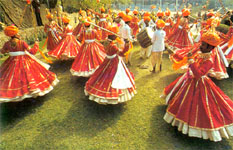 Holi dance full of life and vigour. Another Holi dance of Garasias is
the Chang. One person plays on the chang and many dancers holding
sticks in their hands move and jump in the disorderly crowd. The peculiarity
of the dance lies in the rhythmic jumps and leaps of the dancers who sing
romantic but obscene songs. Women do not join the dance but they accompany
the jumping male dancers with songs.
Holi dance full of life and vigour. Another Holi dance of Garasias is
the Chang. One person plays on the chang and many dancers holding
sticks in their hands move and jump in the disorderly crowd. The peculiarity
of the dance lies in the rhythmic jumps and leaps of the dancers who sing
romantic but obscene songs. Women do not join the dance but they accompany
the jumping male dancers with songs.