|
Maharashtra is the centre of many religious and cultural traditions. In
Maharashtrian villages, life revolves around fairs and festivals.
In early January people celebrate Makar Sankranti, the passing of the sun
from Dhanu (Sagittarius) to Makar (Capricorn). The sky is ablaze with colourful
kites. Sweets flavoured with sesame seed is an important item during this
festival. In March, the festival of Holi is celebrated which is a winter harvest
and the advent of spring. People throw coloured water over each other and have
great fun on this occasion. This is an important festival celebrated all over
north India.
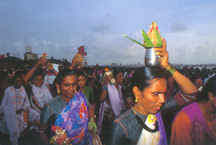
Gudhi Padwa is the new year for the
Maharashtrians. On this day people offer
rituals, prayers, prasad of neem leaves, gram pulse and jagerry and they buy new
clothes. Families erect a gudhi or bamboo staff, with a coloured silk cloth and
a bright garlanded goblet is hung on top of it.
During April, Mahavir Jayanti is celebrated when thousands of Jains make
pilgrimages to Bahubali, where two Jain temples have been constructed one for
the Swetambara sect and another for the Digambara. Christians observe Good
Friday and Easter Sunday around the same time.
Buddha Purnima is celebrated in
May. Muslims celebrate Bakrid in the same month and Muharram is witnessed in
June in remembrance of the Prophet Mohammed on his death anniversary.
The full moon of
Shravana is celebrated around August as Shravani
Purnima,
Rakhi Purnima and Raksha Bandhan. In the coastal areas it is celebrated as Narli
Purnima to appease the sea gods. Fisher folk worship the sea and decorate their
boats, sing and dance, and make offerings of coconut. Raksha Bandhan is
celebrated on the same day in different parts of the state.
The most important Mahrashtrian festival is Ganesh
Chaturthi, in honour of
Lord Ganesh. It is the birthday of Ganesh - the elephant headed son of Shiva and
Parvathi. Ganesh is believed to be the harbinger of good luck who removes all
obstacles to success. He brings prosperity and keeps natural calamities at bay
in the lives of those who worship him. This ten day festival begins with the
installation of the deity, who is then worshipped daily till the immersion on
the final day. Small Ganesh idols are installed in homes. Idols can tower 10m
high and weigh several tonnes. On the tenth day, serpentine processions fill the
streets and with the accompaniment of drumbeats and music the image of Ganesh is
immersed in the water. Devotees chant 'Ganapati Bappa Morya' which means Ganesh,
Daddy, please come back soon next year.
Nag Panchami, the snake festival, is observed at the village called Battis
Shitale in the Sangli district towards the end of August or early September. The
devotees collect hundreds of cobras, place them in earthen pots and worship them
to the accompaniment of folk dances and song. Later they are carried in
processions of bullock carts and chariots. On the following day they are
released into the fields from where they were captured.
Dussehra
and Diwali are celebrated in October and November. Dussehra which is
the celebration of good over evil is an auspicious day for new ventures. Tools
of trade, vehicles and machinery are worshipped on this day. Diwali which is the
festival of lights marks the end of one commercial year and the beginning of
another. Homes are decorated with oil lamps. A unique Maharashtrian touch is
seen in the akash kandeels or lanterns that are hung outside homes. Bhaubij, the
last day of Diwali, is similar to Raksha Bandan and deals with the relationship
between brother and sister
Gokul Ashtami is celebrated in August. Young men form human pyramids to break
pots of curds strung high up from buildings. In the villages, the Pola or the
harvest festival is celebrated in which bullocks are bathed, decorated and taken
out in a procession to the accompaniment of beating drums.
|