Health »
Disease & Conditions »
Pregnancy » Menstruation Cycle
Pregnancy
Menstruation cycle and
Ovulation
The menstrual (monthly) cycle - the periodic
uterine bleeding is one of the key physiological functions of the female body.
Ovulation is release of a matured egg from the ovary. During ovulation if the
egg does not get fertilized (does not meet the sperm), it disintegrates and is
released along with the inner lining of the uterus, (endometrium) causing bleeding.
This process is known as menses or menstrual period.
Menstrual
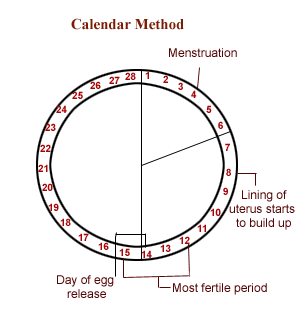
cycle (Time between two periods) usually averages 28 days in length with normal
variation ranging from 21 to 35 days. The day a period starts is counted as day
1 of the menstrual cycle. When the two -seven days of your period are over, the
ovary begins ripening another egg ready for release during the next ovulation.
Meanwhile the uterus begins to build up another inner lining ready to receive
the fertilized egg.
Ovulation normally occurs fourteen days before beginning
the next period, regardless of the length of the cycle. So a woman with
a 28 day cycle would tend to ovulate on day 14. The woman with a 32 day cycle
would tend to ovulate on day 18 (32-14). The life time of the egg is brief -only
24 hours. So to get pregnant the sperm should reach the egg during this fertility
period.
| Viewer's Comment |
| Sundaramoorthynatesan , Tamilnadu 4/6/2012 |
|
|
|
Questions of
Questions & Answers |
|
| 1. |
Posted on :
21.8.2016 By : Jyoti Bahoria , Plot. no. 206 shree durga niwas, rewatinagar BESA
|
View Answer (0)
|
Post Answer
|
|
| |
I am 30 years of age,I am diagnosed with PCOS last year, I always had regular periods and I am mother of a 4 year old boy my problem is my acne which I may facing since last 5to 6 years and it's recurring,I am fed up of this acne is there any treatment please suggest me It will be of great help.
|
|
|
|
|
| 2. |
Posted on :
6.7.2015 By : Poonam , Kolkata
|
View Answer (0)
|
Post Answer
|
|
| |
My mother has got a renal mass in her right kidney approx 7cm and what we understood by her reports was that she has tiny multiple cysts in her lower pole, the doctor has told us that it is not malignant and non enhancing, but we have just done a ct scan and blood tests not even any biopsy so how can he be so sure it is not malignant, she seldom gets a lower back painin her right side, we are taking her to another consulting doctor for a second opinion, as to no what should be done, she is also type 2 diabetic |
|
|
|
|
| 3. |
Posted on :
31.8.2014 By : Litu , Bangladesh
|
View Answer (0)
|
Post Answer
|
|
| |
Hi, I am from Bangladesh. I donated blood to my wife without knowing the fact that it is dangerous. Now she is pregnant of two months. The blood group of both of us is O+. Could you tell me what risks may occur & what precaution should we take? |
|
|
|
|
| » more... |
Note : All statements given are only for information purpose. We are not responsible or liable for any problems related to the utilization of information on this site. We suggest that you consult a qualified doctor before trying any alternative health care remedies.