Health »
Disease & Conditions »
Pregnancy » Reproductive System - Female
Pregnancy
Female
reproductive system
Uterus is a pear shaped
muscular organ about the size of a fist. It is designed to nourish and support
the developing fetus. It can stretch to many times its size during preg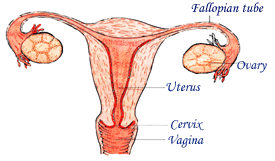 nancy
as the baby grows and contract its powerful muscles to begin the birth process.
nancy
as the baby grows and contract its powerful muscles to begin the birth process.
The inner lining of the uterus, Endometrium is composed of blood
enriched tissue which drops off or sheds each month during a menstrual period.
Uterus
opens into two Fallopian tubes on the upper side as shown in figure. Fallopian
tubes serve as the path way of egg from the ovary into the uterus as well as it
is in the upper portion of one of these fallopian tubes that fertilization (egg
meets the sperm) takes place.
The two Ovaries
on either side of the uterus store eggs and produce the female sex hormones,
estrogen and progesterone which make reproduction possible. The process of ovulation,
the release of a matured egg start from the ovaries.
The
Cervix is the entrance to the uterus, also known as the womb. The Vagina
is a soft, moist, elastic organ which connect cervix to the outside of the body.
Sperm is released into the vagina during intercourse.
Normally
every woman releases a ripened egg from one or other of her ovaries each month
throughout her child-bearing years. On leaving her ovary, the egg is gently guided
along the fallopian tube towards the uterus. During this time sperms produced
by the male testes leave the penis up on ejaculation during intercourse. The sperms
swims up through the cervix and the uterus to the entrance into the fallopian
tubes. If the sperm and egg happen to meet in the fallopian tube, the two may
become fused to create a single cell. This single cell then begins to divide,
eventually implanting itself in the
lining on the uterus or womb, to start a pregnancy.
Questions of
Questions & Answers |
|
| 1. |
Posted on :
21.8.2016 By : Jyoti Bahoria , Plot. no. 206 shree durga niwas, rewatinagar BESA
|
View Answer (0)
|
Post Answer
|
|
| |
I am 30 years of age,I am diagnosed with PCOS last year, I always had regular periods and I am mother of a 4 year old boy my problem is my acne which I may facing since last 5to 6 years and it's recurring,I am fed up of this acne is there any treatment please suggest me It will be of great help.
|
|
|
|
|
| 2. |
Posted on :
6.7.2015 By : Poonam , Kolkata
|
View Answer (0)
|
Post Answer
|
|
| |
My mother has got a renal mass in her right kidney approx 7cm and what we understood by her reports was that she has tiny multiple cysts in her lower pole, the doctor has told us that it is not malignant and non enhancing, but we have just done a ct scan and blood tests not even any biopsy so how can he be so sure it is not malignant, she seldom gets a lower back painin her right side, we are taking her to another consulting doctor for a second opinion, as to no what should be done, she is also type 2 diabetic |
|
|
|
|
| 3. |
Posted on :
31.8.2014 By : Litu , Bangladesh
|
View Answer (0)
|
Post Answer
|
|
| |
Hi, I am from Bangladesh. I donated blood to my wife without knowing the fact that it is dangerous. Now she is pregnant of two months. The blood group of both of us is O+. Could you tell me what risks may occur & what precaution should we take? |
|
|
|
|
| » more... |
Note : All statements given are only for information purpose. We are not responsible or liable for any problems related to the utilization of information on this site. We suggest that you consult a qualified doctor before trying any alternative health care remedies.



