Health »
Disease & Conditions »
Cancer » Bladder Cancer
Bladder Cancer
Bladder cancer
is the most common cancer of the urinary tract. Bladder cancer occurs most commonly
between the ages of 50 and 70. It is twice as common in men as in women. Cancer-causing
agents (carcinogens) in the urine may lead to the development of bladder cancer.
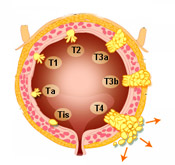 The
bladder is a hollow organ in the lower abdomen (pelvis). It collects and stores
urine, liquid waste produced by the kidneys. Urine passes from each kidney into
the bladder through a tube called ureter
and leaves the bladder through the urethra. The wall of the bladder has several
layers. A layer of urothelial cells (also called transitional cells) lines the
inside of the the kidney, ureter, bladder, and urethra. This layer is called the
urothelium or transitional epithelium. Beneath the urothelium, there is a thin
zone of connective tissue called the lamina propria. The next deeper layer is
a wider zone of muscle tissue called muscularis propria. Beyond this muscle, another
zone of fatty connective tissue separates the bladder from other nearby organs.
As the cancer penetrates through these layers into the wall of the bladder, it
becomes harder to treat.
The
bladder is a hollow organ in the lower abdomen (pelvis). It collects and stores
urine, liquid waste produced by the kidneys. Urine passes from each kidney into
the bladder through a tube called ureter
and leaves the bladder through the urethra. The wall of the bladder has several
layers. A layer of urothelial cells (also called transitional cells) lines the
inside of the the kidney, ureter, bladder, and urethra. This layer is called the
urothelium or transitional epithelium. Beneath the urothelium, there is a thin
zone of connective tissue called the lamina propria. The next deeper layer is
a wider zone of muscle tissue called muscularis propria. Beyond this muscle, another
zone of fatty connective tissue separates the bladder from other nearby organs.
As the cancer penetrates through these layers into the wall of the bladder, it
becomes harder to treat.
Questions of
Questions & Answers |
|
| 1. |
Posted on :
16.1.2015 By : Mitali , Delhi
|
View Answer (0)
|
Post Answer
|
|
| |
My husband is suffer from blood cancer.. He had his first stage.. He took very expensive treatment by still he suffers a lot on his disease..... Is dis possible dat he can be became fit??? |
|
|
|
|
| 2. |
Posted on :
23.5.2013 By : Dharmendra Kumar Singh , Kolkata
|
View Answer (2)
|
Post Answer
|
|
| |
My nephew age 3+ has blood cancer 1st stage, please sugest me low budget hosital in Kolkata. |
|
|
| A1: |
The cheapest Hopital for Cancer treatment is Tata Medical at Rajarhat. It is the best in Eastern Region. |
| |
Posted By :Subho , kolkata | On 11.6.2013 |
|
| A2: |
There is a lot of cancer research is going on at tata cancer centre. You could try there. |
| |
Posted By :Admin , Kochi | On 23.5.2013 |
|
|
|
|
| 3. |
Posted on :
16.8.2012 By : Payalkelkar , Nagpur
|
View Answer (1)
|
Post Answer
|
|
| |
Suggest best treatment for blood cancer 1st stage, and best hosital in nagpur. |
|
|
|
|
|
|
| » more... |
Note : All statements given are only for information purpose. We are not responsible or liable for any problems related to the utilization of information on this site. We suggest that you consult a qualified doctor before trying any alternative health care remedies.



