|
|

Tuesday, April 16, 2024
|
|


| Scientific Name : Solanum tuberosum |
| Family : Solonaceae Family |
| Colour : White, bule, purple or pink |
| Common names : Potato |
| Best Season : October to March |
| Nutritional Value : Calories: 150; 20% starch; Fat: 0.2 g. Rich in iron (skin); fibre (skin); glucids, Vitamin C (especially new potatoes and yellow-fleshed varieties); Vitamin B, mineral salts - magnesium and potassium per 100 g of potatoes. |
| RECIPES |
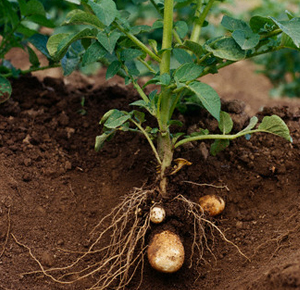 |
Potatoes, a hardy annual plant provides one of the most popular vegetables in the home garden. It is an important staple food and one of the largest food crops in the world. They originate in the Andean mountain region of South America.
The edible part is the swollen portion of the underground stem which is called a tuber and is designed to provide food for the green leafy portion of the plant. Potatoes are covered with a skin and have small "eyes" on their surface from which new buds will emerge. It is an easily grown plant with a good taste and is a very good source of vitamins, fiber and minerals such as copper, potassium, iron and magnesium.
Propagation and PlantingPropagation is through seeds. Potatoes are usually grown from small tubers, called seed potatoes. Seeds selected should be free from diseases. Either a small tuber as a whole or a piece of a larger tuber containing at least one eye can be planted. Large tubers can be cut into pieces with 2-4 'eyes' on each piece. Dry these out for two days in a cool, dry room before planting.
Potatoes require full sun to grow and prefer a slightly acid soil with a pH of 5.8-6.5. When planting them, be sure to allow about a foot of space between each tuber. Rows should have about two feet of space between them. Dig the soil to a depth of 10-15 inches and cover with 2-3 inches of soil and compost at the bottom. Plant seeds in it, the depth allows good root and foliage development. As the potatoes grow up, add more soil and compost. Keep potato plants well watered throughout the summer, especially during the period when they are in flower, and immediately thereafter when the plant is creating new tubers.
VarietiesThere about 100 varieties of this starch tuber plant. They range in size, shape, color, starch content and flavor. Their flesh may be white or colored like the skin. Small types are called "fingerling" or "new" potatoes, larger potatoes are called "earlies" or "main crop".
Norland is a popular red variety that matures early and have medium size tubers. Russet the white skinned potato variety, matures early and have medium size tubers. Kennebec a white skinned potato have medium to large oblong tubers, is a vigorous grower, excellent yielder and is resistant to late blight disease. Katahdin is a white skinned potato variety which have medium-flattened spherical tubers and is a dependable yielder. Yukon Gold Large, yellow-fleshed variety. Red Pontiac, a red skinned variety which is easy to grow, has large round potatoes. Russet Norkotah is a large potatoes have medium to large long tubers. Chieftain a red skinned potato variety have large tubers. Norgold Russet have medium size tubers, oblong to long tuber shape.
Problems and Care :Most potato diseases are seed borne so planting with certified and high quality potato seed is very important in potato production. When large diseased tubers are cut into pieces for planting, this can lead to spreading of diseases and losses. These seed borne diseases have no cure once infected. So care should be taken while choosing the seed.
Early blight is the most common fungal disease of potatoes. Irregular brown or black spots appear on the leafs which expand in size and are frequently surrounded by0 a yellow halo. It may also affect tubers and fruit. Applying fungicides such as mancozeb, Bordeaux or chlorthalonil will help to prevent early blight. High soil fertility also help reduce severity of this disease. Late blight is another fungal disease which is capable of wiping out your entire potato crop. Infected potatoes have shallow, brownish or purplish lesions on the surface of the tuber and on leaves black lesions appear within 3-7 days of infection.The disease thrives in wet weather conditions through spores that can travel through air causing infection. Blackleg is a bacterial disease that can infect potatoes. Once a plant is infected, control is difficult, so prevention is usually best. Sometimes treatment with fixed copper fungicides can be effective. Verticillium Wilt is another disease that can infect potatoes which can be controlled by applications of a sulphur fungicide every 7-10 days. Insect pests that are a major concern are Colorado potato beetle, leafhoppers, aphids and armyworms.
Buying certified disease resistant seed potato varieties and destroying all diseased potatoes and plants can help prevent diseases. Avoid over-watering and planting in areas where other infected plants have grown. Compost and other rotted organic materials, help keep soil borne pests and diseases under control. They also help the soil retain moisture, thus encouraging strong growth. Compost fed plants are less attractive to pests than those given artificial fertilizers. Spraying of sulphur dust and milk on plants also help partially in controlling pests.
Questions & Answers |
|||||||||||||||||||||||||||||
| |||||||||||||||||||||||||||||
| |||||||||||||||||||||||||||||
| |||||||||||||||||||||||||||||
| » more... | |||||||||||||||||||||||||||||
 |
|||
|
|
Tweet | ||
|
|||||||||||||||||||||||||||||||||||