You are in : GARDENING » VEGETABLES » Angled Loofah
Angled Loofah
| Scientific Name : Luffa Acutangula Roxb. |
| Family : Cucurbitaceae |
| Colour : Dark Green |
| Common names : Angled Loofah, Petula, towel gourd, dish-cloth gourd, ridged gourd, silk gourd |
| Best Season : Throughout the year |
| Nutritional Value : 1.09 g protein, 17 mg calcium,1.6 mg iron, 5.6 lU vitamin A, 7 mg vitamin C per 100 g serving. |
| |
A warm season plant, Angled loofah is a fast growing annual climbing vine,
native to India. Nutritive value of this vegetable is low. But even then,
consumption-wise it is a popular vegetable.
The plant has fast climbing wines which grow up to a considerable height,
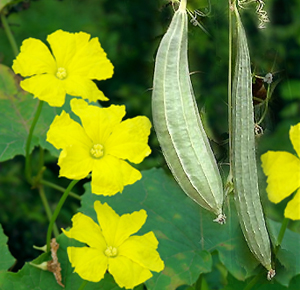
with leaves which are lobed severally. The plant produces flowers, both male and
female and the male flowers are large, bright yellow in colour and are found in
clusters whereas the female flowers are few in number and stand alone. Fruits
are tubular 4-6 inches long, with ten elevated angular ridges with a rough
surface and spongy flesh inside.
Propagation and Planting :
This warm season plant is sensitive to frost. It yields well in warm climates. The
plant prefers deep well drained sandy loam soils, rich in organic matter with a pH
ranging between 6.5 to 7.5. But it can also be grown on any good soil. The soil
may be prepared well by adding organic matter or animal manure a few weeks
before planting.
Planting can be propagated by direct seeding or transplanting. The seeds should be planted about 1-2 inch deep in the soil. Transplants
can be done when 2-3 leaves develop and should be done in such a way as to avoid
disturbance to the root system. The plants require a lot of space to grow and
should be placed at a distance of 3 to 4 feet apart in rows. Place poles of any
wood or bamboo 2m high as support and give wire or twine supports in rows. The
plant requires only little water but regular watering is essential. Too much
water during flowering and fruition is harmful to the plant.
Flowering and fruition will occur around 6 weeks after sowing. Fruits
are picked when they are dark green at the tender stage, before the angular
ridges outside harden and fibrous network develops inside. Once mature, they
become bitter and inedible. While cooking, ridges of the loofah can be peeled
off thinly but the remaining portion with skin is edible.
Problems and Care :
Prune all side shoots on the main stem till about 1 metre from the ground.
Less the number of fruits, more will be the size of the fruit.
Angled loofah is susceptible to many diseases and insect pests, such as
nematodes, viruses, powdery mildew, leaf miners and spider mites. The major insect pests are
fruit flies and aphids. Powdery mildew can be controlled by
applying benomyl or sulfur dust. Fruit flies can be sprayed with protein hydrolysate mixed with insecticide.
Leaf feeding beetles can be controlled by spraying with carbaryl of endosulfan. The
insects can also be controlled by wrapping fruits with newspapers, when they are
about a few centimetres long.
Questions of
Questions & Answers |
|
| 1. |
Posted on :
20.8.2013 By : Shibu Daniel , Jaleeb Al Shoukh
|
View Answer (2)
|
Post Answer
|
|
| |
WHAT TYPE OF CLIMATE IS SUITABLE FOR CLOVES TO GROW? |
|
|
| A1: |
how long will it take to grow plant |
| |
Posted By :Sumaiya , vijayanagar | On 8.3.2017 |
|
|
|
|
| 2. |
Posted on :
28.8.2012 By : Srinivas , Hyderabad
|
View Answer (2)
|
Post Answer
|
|
| |
Ever time i grow ladies finger plants, they are stunted, they dont grow more than 1 feet height, they just flower poorly and dry. Does it specifgy any nutrional deficiency?? |
|
|
| A1: |
Use indian cow dung and urine as fertilizer. You should get good result. Also use non-hybrid seeds. |
| |
Posted By :Kiran , Pune | On 23.2.2015 |
|
| A2: |
Request you to kindly purchase good quality of seeds, pls verify your soil is ok or not, if not pls mix soil & compose approx 70/30 share and put ur seeds 3days in sunlight before panting. |
| |
Posted By :Alok Kayal , Secunderabad | On 2.1.2013 |
|
|
|
|
| 3. |
Posted on :
17.1.2012 By : Gangadhar , Secunderabad
|
View Answer (0)
|
Post Answer
|
|
| |
Am planning to cultivate pumpkin and thinking to sow seeds in january month end is there any risk and what will be the average yeild per acre at maturity. |
|
|
|
|
| » more... |