|
|

Thursday, April 25, 2024
|
|


| Latin Name : Myristica fragrans |
| Family : Myristicaceae |
| Genus : Myristica |
| Common names : Nutmeg, nutmeg flower, black caraway, flower seed, black cumin, nigella seed, bishop's wort, small fennel flower |
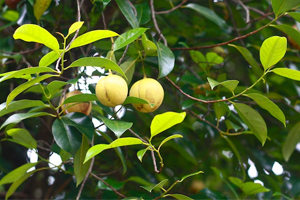 |
The tropical evergreen tree Nutmeg, is native to Molucca Islands of Indonesia. Now it is widely cultivated in the West Indies, South Africa, India and other tropical areas. Nutmeg and mace are different parts of the same fruit of the nutmeg tree. Both spices are strongly aromatic, resinous and warm in taste.
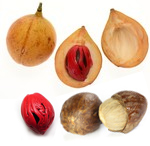
This aromatic tree grows to about 70 feet with numerous branches, has pointed dark green 5" long leaves that are arranged alternately and are borne on leaf stems about 1 cm long. The bark contains watery pink or red sap. Pale yellow, waxy, fleshy and bell-shaped flowers are usually single sexed; occasionally male and female flowers are found on the same tree. The reddish-yellow oval shaped fleshy fruit, when ripe splits into 2 valves revealing a purplish-brown, shiny seed (nutmeg) covered by a bright red aril (mace). The seed is about an inch long and lasts for years in its whole form.
Nutmeg is commonly used for seasoning foods. It is used mainly in sweets and mace in spicy dishes. This culinary spice is also used in perfumes and as a medicinal plant. It helps prevent gas and fermentation and is good for nausea and vomiting. Fresh fruit is used locally for preserves and pickles. Nutmeg is available both whole and ground.
Propagation, Planting and Harvesting :
The nutmeg tree thrives in a hot, moist climate and in well-drained soil with partial shade. Shade is required for the first two to three years. They need year-round water, but should not be kept wet, as the roots will rot.
Nutmeg is propagated through seeds. To obtain nutmegs both sexes should be planted. Male and female type trees are required for pollination and fruit set. One male is sufficient to pollinate ten to twelve females. Instead of a nutmeg male, a cocum male tree is enough to pollinate nutmegs. Dark brown seeds from fruits that have split open should be used and have to be sown as soon as possible. The soil must be enriched with mixture of well-composted manure, topsoil, and coarse sand. Germination takes between four and eight weeks. The seedlings should remain in the shade for six to eight months. The seedlings can be planted in the field at the beginning of the rainy season. Shading can be gradually removed after two to three years.
Pruning will help to maintain flower, fruit and seed production. The trees will begin to bear fruit from around seven to nine years. Yield depends on the size and age of the tree. The yield will increase considerably and continue bearing for seventy or eighty years. The fruits are ready for harvest in about 9 months after flowering. The peak harvesting season is during June-August. The fruit of nutmeg tree, which is similar in colour and size to apricot, when ripe splits into two halves exposing a purplish-brown shiny seed surrounded by a brilliant red aril. Usually the fruits are allowed to split and fall to the ground before harvesting.
The seeds are collected when the fruit splits. The outer fleshy portion is removed and the scarlet aril is carefully separated from the nut. Mace is flattened and both are dried separately either in the sun or by passing hot air. On drying mace becomes yellowish brown and brittle. Seeds are dried for about two months, until the kernel rattles within the shell, which is then cracked and removed.
Mace is used to flavour milk-based sauces and is widely used in processed meats. It is also added sparingly to delicate soups and sauces with fish or seafood. Pickles or chutneys may be seasoned with mace. Nutmeg is a traditional flavouring for cakes, gingerbreads, biscuits and fruit or milk puddings. The fleshy pericarp can be used for making pickles, jams and jellies
Problems and Care :
The most threatening disease is Nutmeg Wilt, in which the plant will gradually wilt and drop leaves and fruit. There is no definitive treatment. Soil fungi will attack nutmeg trees. The main pests are borers, or bark beetles, which are small dark brown weevils about 3mm long.
Manures are applied in shallow trenches or pits dug around the plants. Pruning will help to maintain flower, fruit and seed production.
Questions & Answers |
|||||||||||||||||||||||||||||
| |||||||||||||||||||||||||||||
| |||||||||||||||||||||||||||||
| |||||||||||||||||||||||||||||
| » more... | |||||||||||||||||||||||||||||