Odissi - Movement Patterns
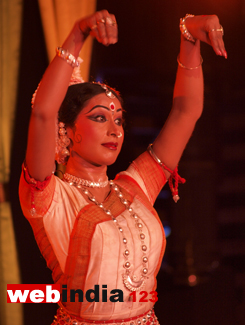
The
movement technique is developed from the basic position. There can be the
possibility of walking in space, in different directions, in different manner
and at different levels. The most characteristic amongst these is the semi-circular
walk or the covering of space by one leg, more specifically the calf in semi
circles, returning back to centre. The other half of the body is static. The
same as the Minadandi i.e. covering space like a fish. There is then the manner
of covering space in circles, half circles and concentric circles. This is
known as ghera.
From the tribhanga position emerge another group of movement.
One half of the body is kept static along the vertical median, one knee
continues to be bent and the other leg is either extended to the
side or to the front or to the back. It can cross the static
foot at the back or the front, it can be elevated at different levels and it can
be totally extended at the back with the knee bending or calf and thigh in
a straight line. Through a sitting or a kneeling position another group of
movements emerge. The most characteristic amongst these is the extension
of one leg to the side or to the back while one foot and knee are in
contact with the ground. These movements arise out of the sitting position known
by the generic term baitha. Another group of movements emerge out of basic
position of the chauka or the mandalasthana. Here either movement can be in
place i.e. the feet can be static and only the torso can move or a complete
pirouette can be executed holding the chauka position. Weight rests on the bent
leg and the free leg executes a pirouette .
The Odissi technique has developed many single leg movements
called the ek pada chari or using both legs or the feet called the dvipada
charis and innumerable other ways of depicting the pose which can be seen in the
sculptures reliefs in the Orissan temples. The dancer controls her body in the
manner in which the sculpture pose is held for a spilt second only to get back
into a series of movements termed. The sculpturesque quality of Odissi dance is
dependent on perfect execution of these charis.
Another group of movements termed as Bhramaris are equally
important. These are the spins or the pirouettes. Pirouettes can be executed in
the tribhanga position or the chauka, both clockwise and anticlockwise and
they can be executed in the standing position. Pirouettes also emerge from the
three basic positions of the samapada, the tribhanga and the chauka. There is a
simple bhramari, a bhramari with a jump therefore called an ut-pluta bhramari or an
anti-clockwise pirouette called Viparita bhramari. There is also the bhramari
called the antara bhramari. Here one foot touches the knee of the other leg and
a pirouette is executed. The movement patterns of Odissi dance emerges
from the positions, the manner of covering space and the method of
executing the bhramaris.
There are then the group movements which may be called
elevations, jumps or Utpluta. There is whole group of movements in Odissi dance where
jumps and hopes are suggested and there is lack of contact with the ground.
There are the sculptural poses which can contained within the
dance techniques. From the tribhanga can emerge many sculptural poses which have
been given different names some suggesting the type of heroines i.e. nayikas,
others suggesting the type of movement i.e. half bent, full bent
etc and yet others suggesting an approach movement in Odissi dancing are called
bhangis or sometimes the thais.



