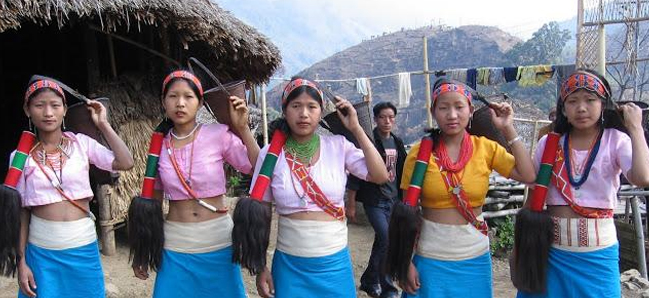
| Solung -Adi festival
The 'Solung' is the main festival of 'Adis' and is a manifestation
of the Adis festival cult. There are various stories about its origin,
but the most commonly accepted one is that the Adis were asked by Kine-nane,
the Goddesses of wealth and prosperity to perform the Solung Puja.
The
story goes like this. One 'Doying-Bote' (god of heaven) came in contact
with Kine-nane and become sexually excited. When he was about to copulate
with her two monsters Totel-Mone and Dubeng-Mone, intervened and snatched
off his testicles to destroy it and in the process scattered the divine
sperms over different places from some of which sprouted paddy plants.
This was found by Kine-nane. Finding human beings starving for want of
food, she sent the paddy seeds through a dog. Since then men have been
producing paddy in plenty to meet their requirement of feed. Kine-nane
asked the men so helped by her to offer Puja in the name of Solung which
they were only too willing to do. Kine-name also helped them to acquire
Mithun, and pig, the two animals which are sacrificed at the time of Solung.
In the Solung they try to propitiate both Doying-Bote
and Kine-nane and if they are pleased and satisfied the former will appear
in the form of clouds and rains and latter will appear in the form of
great fertility of soil. They land together on the surface of the earth
where ultimately their union take place. It is believed that their successful
union will lead to high yields of crops, more animals like mithun, pigs
etc and ultimately wealth and prosperity for men.
Solung celebration continues for five days, first day
is called, 'Solung-Gidi Dogin' or the day of preparations, second and
the main day of the celebration is called Doreph-Long (the day of animal
sacrifice), third day is 'Binnayat Binam' or worshipping the goddess of
plenty and prosperity. Fourth day is Yaktor of Ekoph when the villagers
remains busy preparing bows and arrows and other weapons of war. On the
fifth day the Miri (religious leader or priest) is given a ceremonial
send off when the girl's sing and dance. During Solung festival, every
evening the Miri sings 'Solung Abung' and through the song he relates
the stories about the origin of man, animals and plants, ancestry of the
Adis, lives and deeds of the Adi Heroes. Solung is celebrated in the month
of August or September but there is no fixed date for it. Now-a-days in
some places, the festival is celebrated with a three day programme. Solung
is celebrated to reap a rich harvest after sowing of seeds and transplantation
of paddy plants, to raise more mithuns and pigs and also to be free from
natural calamities, fire, accidents, diseases etc.
|