|
|

Thursday, April 25, 2024
|
|


|
||||
| Reh - Idu Festival
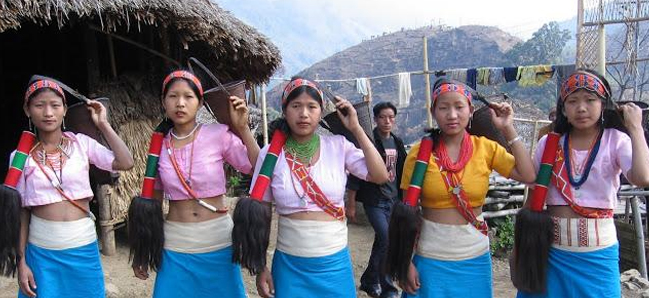
The festival is celebrated during February-August. The people who inhabit snow fall areas viz. Talo, Amru, and Dri villages of the Dibang valley celebrate it during summer and monsoon i.e. during June-August, when the climate is moderate and shoal of fishes are available in streams and rivers. The Idus in the other parts celebrate the same during February to May. The festival requires a number of sacrificial buffaloes for offering to the great mother 'Nanyi Inyitaya'. Presents such as money in cash and pigs are given to the relatives. The festival being very expensive, all arrangements and preparations for the festival have to be made four or five years before the actual celebration of the festival. As such a person wanting to celebrate this festival has to take resort to the system locally called 'Ada' which is nothing but collection of mithuns, pigs, cash, money etc., even by way of loan from others. When 'Ada' is completed a tentative year is fixed about one year ahead of the actual celebration. The preparation of rice beer in large scale locally called 'Yunyiphri' is under taken, three to four months before the actual celebration. After all necessary arrangements and preparations are made, 'Tayi' a form of calendar is served to all kith and kin as an invitation to come to the celebration on scheduled dates. The 'Tayi' is counted by knots on a string and each knot is cut off as a night passes on, one after another. The invited kith and kin arrive at the place of celebration when two knots remain on the string. The Reh festival is celebrated for 6 days. The first day is called Andropu'. It is observed by offering prayers so that the festival may pass off smoothly. The mithuns are brought and tied near the house. The 'Naya' dance is held during the night. Eyanli is the second day and may be termed as killing day of animals such as mithuns and buffaloes. The guests are entertained with rice, meat and rice beer. The third day is called 'Iyili'and on this day heavy feast is arranged and everybody is entertained. Presents of meal-rice are also supplied to the neighbouring villagers who fail to come to the festival.
Ilyiromunyi is the fourth day of the festival. There is not much feasting on this day. The priest only performs the rituals in favour of worshiper for bestowing upon him wealth, all round prosperity and for general well-being. Omen is observed by pouring 'Yu' rice beer into the ears of a pig, bound and laid on the ground. If the pig does not fidget, it is considered evil and result in bad crops, epidemic etc otherwise it is good. The fifth day is called Aru-Go. On this day the remaining food stuff and other drinks are prepared for the feast and taken with co-villagers. The sixth day is the concluding day of the festival is known as 'Etoanu'. On this day the blood smeared seeds are sown in the fields and rice beer is poured at the trunk of the stump for the goddess of the house hold. |
||||
|
|||||||||||
|
|||||||||||
Related Links |
| ▪ Government |
| ▪ Classifieds |
| ▪ Education |
| Last Updated on : 17 April 2018 |


 Reh is one of the most important festivals of the Idus. The Idus
believe that they are the sons and daughters of the divine mother 'Nanyi
Inyitaya'. But none can get her blessings and keep alive bond of brotherhood
and social feeling strong, unless one performs the puja or celebrate the
Reh festival. But it is so expensive that only a few people can afford
to celebrate the festival for propitiation of the supreme creator, the
great mother 'Nanyi Inyitaya'.
Reh is one of the most important festivals of the Idus. The Idus
believe that they are the sons and daughters of the divine mother 'Nanyi
Inyitaya'. But none can get her blessings and keep alive bond of brotherhood
and social feeling strong, unless one performs the puja or celebrate the
Reh festival. But it is so expensive that only a few people can afford
to celebrate the festival for propitiation of the supreme creator, the
great mother 'Nanyi Inyitaya'.