|
|

Thursday, April 25, 2024
|
|


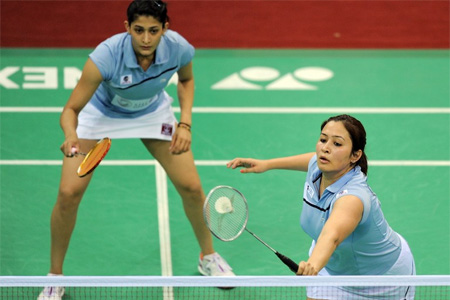
Before the commencement of the play, the opposing sides shall toss and the side winning the toss shall have the option of either Serving or choosing ends.
The game shall be played by two players on each side in the case of the doubles and by one player on each side in singles. The side having the right to serve shall be called the "in" side (serving side) and the opposing side shall be called the "out" side (receiving side).
The server and the player served to, must stand within the limits of their respective service courts (as bounded by the short and long service, the center and side lines) and some part of both feet of these players must remain in contact with the surface of the court in a stationary position until the service is delivered. A foot on or touching a line in the case of either the server or the receiver shall be held to be outside his service court. The respective partners may take up any position, provided they do not un-sight or otherwise obstruct on opponent.
If the server, in attempting to serve, misses the shuttle, it is not a fault. But if the shuttle is touched by the racket, a service is thereby delivered. The shuttle is thereafter 'in play', until it touches the ground or a fault or "let" occurs. If a player serves out of turn, or from the wrong service court (owing to a mistake as to the service court from which service is at the time being in order) and his side wins the rally, it shall be a "let". After the service is delivered the server and the receiving player may take up any position they choose on their side of the net, irrespective of any boundary lines.
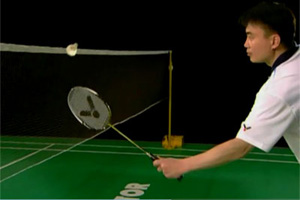
If, when in play, the shuttle strikes the net and remains suspended there or strikes the net and fall towards the ground on the strikers side of the net or hit the ground outside the court and an opponent then touches the net or shuttle with his racket or person, there is no penalty as the shuttle is not then in play.
If a player has a chance of striking the shuttle in a downward direction when quite near the net, his opponent must not put up his racket near the net on the chance of the shuttle rebounding from it. This is obstruction.
In singles play, the players shall serve from and receive service in their respective right-hand service courts only when the server's score is 0 or an even number of points in the game. The service is delivered from and received in their respective left-hand service courts when the server's score is an odd number of points. Setting does not effect the sequence. Both players shall change service courts after each point has been scored.
After the decision as to which side is to have the first service, the player in the right-hand service court of that side commences the game by serving to the player in the court diagonally opposite. Only the same player of the side beginning a game shall be entitled to serve in its first innings. In all subsequent innings each partner shall have the right to serve and they shall serve consecutively. The side winning a game shall always serve first in the next game, but either of the winners may serve and either of the losers may receive the service.
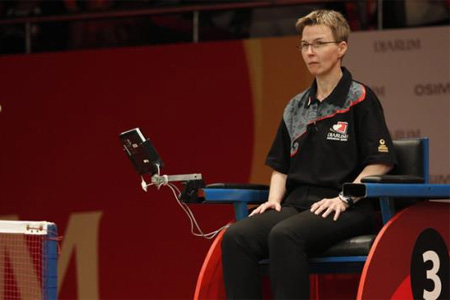
It shall be the duty of the umpire to call 'fault' or 'let' without appeal being made by the players and to give him a decision on any appeal regarding a point in dispute, if made before the next service. He will also appoint lines men and service judges at his discretion. The umpire's decision shall be final, but he shall uphold the decision of a linesman or service judge. This shall not preclude the umpire also from faulting the server or receiver. Where a referee is appointed, an appeal shall lie to him from the decision of an umpire on question of law only.
|
|