|
|

Tuesday, June 9, 2026
|
|


|
||||
|
Ladakhis 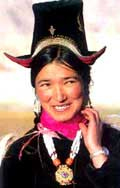 The people of Ladakh region have Mongoloid or more accurately Turanian features. People of this region have a cheerful disposition and are peace-loving. According to the 1971census, the population of Ladakh was estimated at 105,000. Fifty-five percent of the Ladakhis are Buddhist by faith and the rest are Muslims. Ladakh is known as the 'land of the Lamas' and the Buddhist of Ladakh prefer to call their religion Lamaism - which is much the same as Mahayana (or Great vehicle) form of Buddhism. Religion pervades the life of Ladakhis and dominates their life-style. The people of Ladakh have a system of dedicating at least one person from each family to priesthood, i.e. to be a Lama. The female monk is called Chomo. The Dalai Lama of Tibet is to them the chief spiritual head. Ladakhis call themselves 'Bo-pa' i.e. ancient Bhauttas. They speak a Tibetan language which is a dialect of Tibetan. It is written in the Tibetan script. Many words in the Ladakhi language, especially in religious terminology are derived from Sanskrit. Ladakhis are sincere and honest. About 90 percent of them depend on agriculture for their livelihood. Barley, wheat, buck-wheat, peas, rapeseed and beans are the main agricultural products. Apples and apricots are grown in warmer regions of low altitude. Another occupation of the Ladakhis is sheep-rearing. The herdsmen are called Chang-pas. They rear long-haired goats and sheep from whose under-fleece the famous Kashmiri Pashmina shawls are made. Chang-pas live in tents and are nomadic, going from place to place in search of pastures. Ladakhis are keenly interested in trade. Wool, in raw form is their chief commercial product. The men travel long distances, seeking favourable prices for their wares, which consist of salt, dry fruits and cultured pearls and semi-precious stones. In return they get tea, tobacco, grain, sugar and other essential goods. Ladakhi men wear long, grey, woolen gowns fringed with sheep-skin and tied at the waist with girdles of blue colour, multi-coloured velvet caps, fringed with black fur earlaps. Their women wear colourful clothes. Their special turquoise-studded headgear called Perak, is made of red cloth or goat skin and hangs up to the forehead and tapers down to the waist at the back. Brooches of turquoise and other semi-precious stones embellish their headgear, bangles and ear ornaments. The staple food of the Ladakhis is 'grim' - a kind of barely grown abundantly even at high altitudes - which is eaten as bread or mixed with butter and tea as a paste. They are invariably meat-eaters. A local drink called Chang is consumed in ample quantities at festive occasions and reception following marriages and births. Polyandry used to be a common feature among the Ladakhis. The elder brother's wife was the wife of all brothers. This system was mainly with an aim to keep the population steady and patrimonial property undivided. This system has been discarded by the young Ladakhis, but there is no law yet against polygamy. Playing polo on fast-racing ponies is the most popular entertainment in Ladakh. The horse is not changed with each Chukkar (Chukka) as in western style polo but each player carries on with the same sturdy pony. Primitive wooden balls are still used for the game played on rough, uneven pitch whose popularity persists in Ladakh.
Ladakh offers the hunters exotic hunts of markhor, ibex, red bear, snow leopard, wild sheep, antelope, gazelle and marmot. Ladakh is also rich in minerals like gold, copper and semi-precious stones. There is a system of medicine known as Amchi system of medicine which is based on Ayurveda. Amchis, as the Ladaki doctors are known, have been handling down their medical knowledge from father to son down the years. Recently, however, an Amchi college has been started in Ladakh for training and certification of Amchis, It is a well developed system of medicine which treats the individual as a whole and remedies include mostly herbal extracts from plants which grow in the high altitude region of Ladakh. Some minerals and animal products are also used as remedies which treat a whole spectrum of physical and mental problems. The Indian Army has taken up a unique project to examine the usefulness of the Amchi system of medicine found in Ladakh. |
||||
|
||||||||||||||||||||||||
|
||||||||||||||||||||||||
Related Links |
| ▪ Government |
| ▪ Classifieds |
| ▪ Education |
| ▪ Yellowpages |
| ▪ Photo Gallery |
| Last Updated on : 21 May 2018 |