|
Rasa
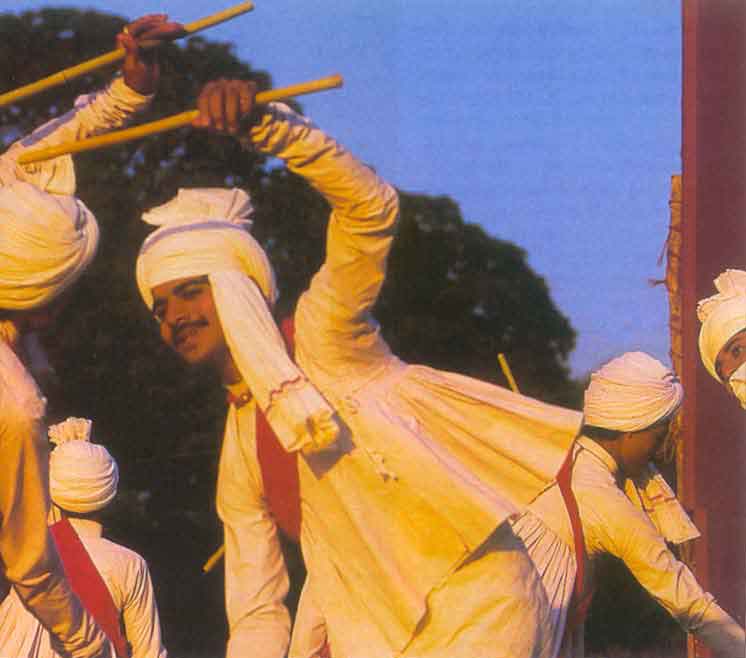 A form of dance which is supposed to belong to Kutch and
Suarashtra is performed all over Gujarat. The rasa traditions
are as old as the Puranic
period. In various parts of the country, Rasa are danced in different
manners. The main feature of Rasa is dancing in a circle by men and woman,
to the accompaniment of musical instruments and keeping time
either by clapping or beating of two sticks. The number of dancers go
from 8,16, 32 up to 64 couples, who also sing the song. There are
three varieties of Rasaka described. A form of dance which is supposed to belong to Kutch and
Suarashtra is performed all over Gujarat. The rasa traditions
are as old as the Puranic
period. In various parts of the country, Rasa are danced in different
manners. The main feature of Rasa is dancing in a circle by men and woman,
to the accompaniment of musical instruments and keeping time
either by clapping or beating of two sticks. The number of dancers go
from 8,16, 32 up to 64 couples, who also sing the song. There are
three varieties of Rasaka described.
-
Danda Rasaka-Rasa dance where Danda or sticks are
used.
-
Mandala or Tala Rasaka-Rasa dance
where clapping is used.
-
Lata Rasaka-Rasa dance where dancers cling to each
other and dance like a creeper to a tree.
Most
of the art traditions of Gujarat trace their origin to the mythological
times of Lord Krishna. He is said to have been an exponent of art of dancing.
Raas Nritya is a form of dance performed by lord Krishna with Gopikas.
The Dandia variety of the Raas Nritya of Gujarat is generally performed
by a group of youthful persons, both males and females, who move in circles
to measured steps, beating time with small sticks (called dandia) singing
to the accompaniment of Dhol, Cymbals, Zanz, flute or Shehnai. When
the time beat is given by the clapping of palms and performed only
by males, it is called Garbi.
The Gof variety of the raas is an intricate performance
wherein the performers holding coloured strings attached to a top, move
in circles weaving and unweaving different patterns.
The Mers of Saurashtra are known for their folk dance
called the Mer Raas. White shepherds perform what is called the
Gher Raas. The Gheria Raas is a dance performed by the agriculturists
of south Gujarat.
|